USAID DEC
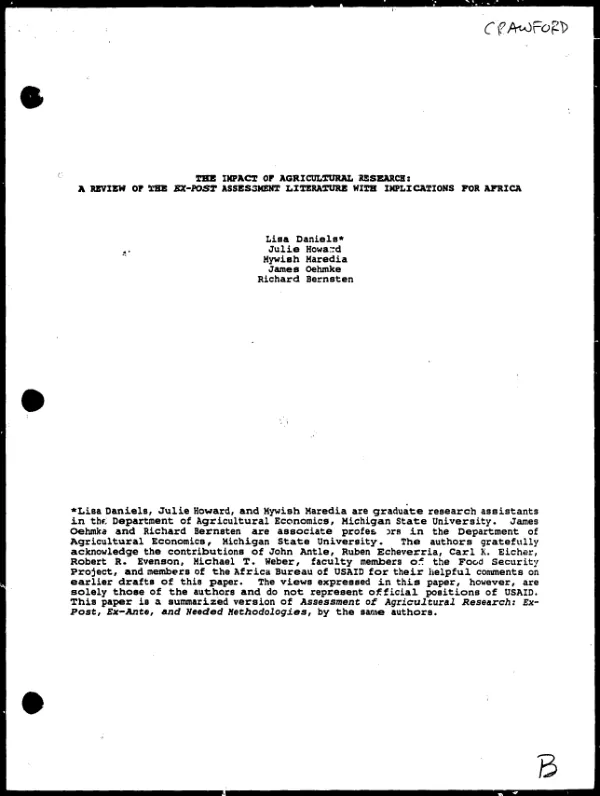
Impact of agricultural research : a review of the ex-post assessment literature with implications for Africa
Sign inMICHIGAN STATE UNIVERSITY. DEPT. OF AGRICULTURAL ECONOMICS
Impact of agricultural research : a review of the ex-post assessment literature with implications for Africa
This paper reviews the literature on ex-post evaluation of agricultural research with emphasis on the implications for African research policy.
Daniels, Lisa; Howard, Julie · 1970
Sign in to readA free account is required to download.
Abstract
Both rate of return (ROR) and non-ROR studies are included. The ROR literature reveals a paucity of information on the performance of African agricultural research. Only four rate of return studies for sub-Saharan Africa were identified, compared to a far greater number for developed countries, Latin America, and Asia. The non-ROR studies, while offering recommendations for improvements in research institutions, do not allow a rigorous comparison of research impact due to the variety of methodologies employed and their qualitative nature. Several implications for African research policy can be drawn from the literature. First, the large majority of studies around the world reveal that research benefits far exceed costs; however, success depends crucially on complementary infrastructure, institutions, and government policies. This is particularly important in Africa where institutions and infrastructure vary widely in structure and effectiveness. Second, more African ROR studies are necessary in a wide array on agro-climatic and economic environments to identify conditions for effective research. Third, the appropriate evaluation methodology depends on available resources and objectives. In order of increasing sophistication and cost, the alternatives include descriptive studies, average ROR studies, and marginal ROR studies. Fourth, governments need to consider producer and consumer benefits of agricultural research when allocating funds among projects. Finally, sustained investments in research and continuity are required to achieve the anticipated payoffs. (Author abstract)
Related documents
Documents in this collection
![National agricultural research systems" (NARSs) [i.e. NARS"] vision of international agricultural research : the sub-Saharan African perspective](https://covers.devme.ai/gen/25734.webp) 1970
1970USAID DEC
National agricultural research systems" (NARSs) [i.e. NARS"] vision of international agricultural research : the sub-Saharan African perspective
Open record 1996
1996USAID DEC