USAID DEC
Impact of export processing zones (EPZs) on labor in Latin America : with a focus on gender
Sign inHARVARD UNIVERSITY. HARVARD INSTITUTE FOR INTERNATIONAL DEVELOPMENT (HIID)
Impact of export processing zones (EPZs) on labor in Latin America : with a focus on gender
The effect of export processing zones (EPZs) on labor markets (particularly women) in Costa Rica, the Dominican Republic, and Mexico is studied in this report.
Robbins, Donald · 1992
Sign in to readA free account is required to download.
Abstract
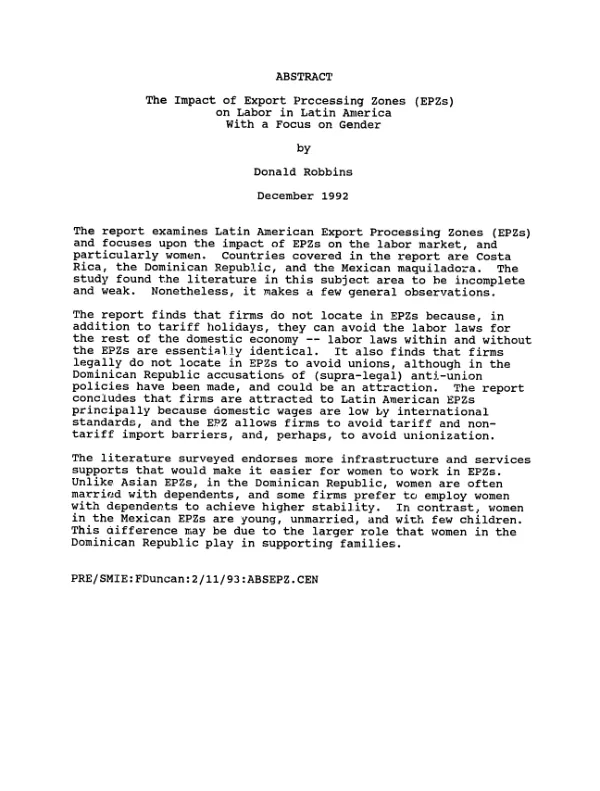
The study found the literature available on the subject to be incomplete and weak, but a number of consistencies and worthwhile observations emerged. The first section discusses the legal and regulatory framework of EPZs generally. Section II summarizes the literature on labor markets, particularly with regard to female employment. This section covers only the Dominican Republic and Mexico; study of the Costa Rican labor market had to be abandoned because virtually nothing is known about it. Section III discusses the policy literature, and Section IV discusses recommended studies. Appendices present tables summarizing the available data on labor market aspects of Latin American EPZs. The report concludes that firms do not locate in EPZs because they can avoid the labor laws for the rest of the domestic economy -- labor laws within and without the EPZs are essentially identical. Rather, firms are attracted to Latin American EPZs principally because wages are low by international standards, and the EPZ allows firms to avoid tariff and non-tariff import barriers, and, perhaps, to avoid unionization. The literature surveyed endorses more infrastructure and services that would make it easier for women to work in EPZs. It found that Dominican EPZs employ women who are often married and with dependents to achieve higher stability. In contrast, women in the Mexican EPZs are young, unmarried, and with few children. The difference may be due to the larger role that women in the Dominican Republic play in supporting families. (Author abstract, modified)
![Five [i.e. Eight] country profiles : Costa Rica, Dominican Republic, El Salvador, [Guatemala,] Honduras, [Mexico,] Nicaragua, Panama](https://covers.devme.ai/gen/43957.webp)