THE FUTURES GROUP INTERNATIONAL, INC. (TFGI)
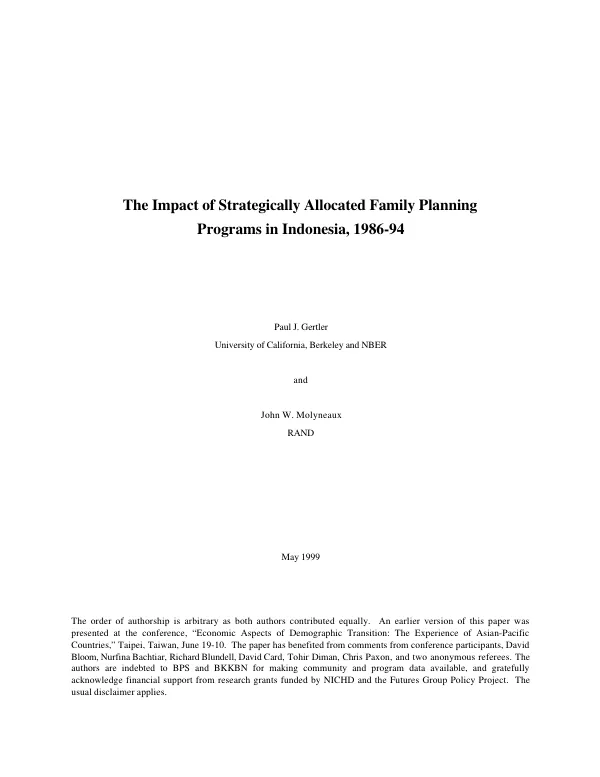
Impact of strategically allocated family planning programs in Indonesia, 1986-94
This paper investigates the effects of public family planning programs on fertility in Indonesia over the period 1986- 94, controlling for economic growth and improvements in the status of women.
Gertler, Paul J.; Molyneaux, John W. · 1999
Sign in to readA free account is required to download.
Abstract
A major stumbling block to measuring these impacts is that family planning programs are not randomly placed. Moreover, if, as in the case of Indonesia, the government allocates program inputs to areas of greatest need and updates the allocations based on performance, standard methods of controlling for this problem, such as fixed effects analysis, yield inconsistent estimates. The study solves this problem by explicitly modeling the government"s allocation process together with the impact analysis. Using these methods, the study finds that total National Family Planning Coordinating Board (BKKBN) expenditures on contraceptive subsidies lowered fertility by about 3-6%. By contrast, a 50% improvement in the distribution network (including public health clinics and community-based distribution systems) lowered fertility by about 12%. However, these policies are expensive; BKKBN"s contraceptive subsidies represent roughly 50% of their annual expenditures, while the costs of the distribution network are paid largely out of other ministerial budgets. (Author abstract)
Connected topics