USAID. MISSION TO PANAMA
Improved electoral administration
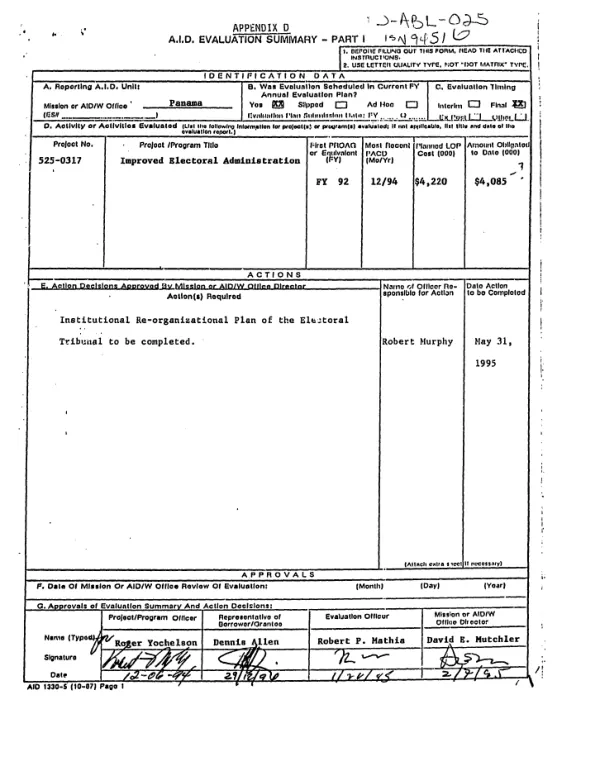
Summarizes final evaluation (PD-ABK-081) of a project (9/92-12/94) to strengthen the institutional capability of Panama"s Electoral Tribunal to support free, fair, and open elections in May 1994.
1995
Sign in to readA free account is required to download.
Abstract
The project was notably successful in meeting all its objectives. By every measure, the 1994 elections, considered by former President Jimmy Carter and his international observer delegation the cleanest and most transparent they had ever witnessed in Latin America, were a surprising success: voter participation was high, violence was non-existent, there were no complaints of fraud or error, unofficial results were reported rapidly, and results were accepted immediately by all candidates. The role played by the Electoral Tribunal was critical to this success and would not have been possible without the project"s institution-building assistance. Significant accomplishments included an improved information technology system, strengthened planning and training functions, and improved accuracy of the civil and electoral registries. An aggressive and creative voter motivation and education campaign was also instrumental to the success of the elections. The following lessons should be taken into consideration in future programs to improve electoral administration. (1) The project responded to and benefited from strong commitment to free elections on the part of President Endara, the Electoral Tribunal Magistrates and their staff, political parties, and the citizenry. (2) Coordination at all levels was very effective. (3) Cleansing of the electoral registry was key to gaining the Panamanian people"s trust in the Electoral Tribunal. The approach taken actually got the public involved in helping with the electoral process. The many imaginative ways (publicity campaign, kiosks, fair, tee shirts, use of telephone and other bills) by which the Tribunal involved the public were a major factor in the successful election. (4) Improved information technology played a key role in improving the civil and electoral registries, the identity card system, and the election day support systems. USAID/W/IRM involvement in planning these information systems was very successful. (5) Also helpful was USAID/P"s flexibility in supplementing TA from the Centro de Asesoria y Promocion Electoral (CAPEL) with the more cost-effective assistance of the Fundacion Cruzada Civilista Nacional/Centro Pro-Democracia (FCCN/CPD) mechanism, as well as its use of direct rather then host country procurement to sidestep the conflict between the Contraloria and the Electoral Tribunal. (6) Exchanges with Electoral Tribunal personnel from other countries were very beneficial, especially those with other Latin Americans. CAPEL deserves credit for stimulating such exchanges, which have more credibility and impact than exchanges only with Northern democracies. Further institutional strengthening of the Electoral Tribunal is needed, and some specific steps are recommended.
Related documents
Documents in this collection
 1994
1994USAID DEC
Final report : evaluation of the improved electoral administration project (project no. 525-0317)
Open record 1997
1997USAID DEC