USAID. MISSION TO ZIMBABWE
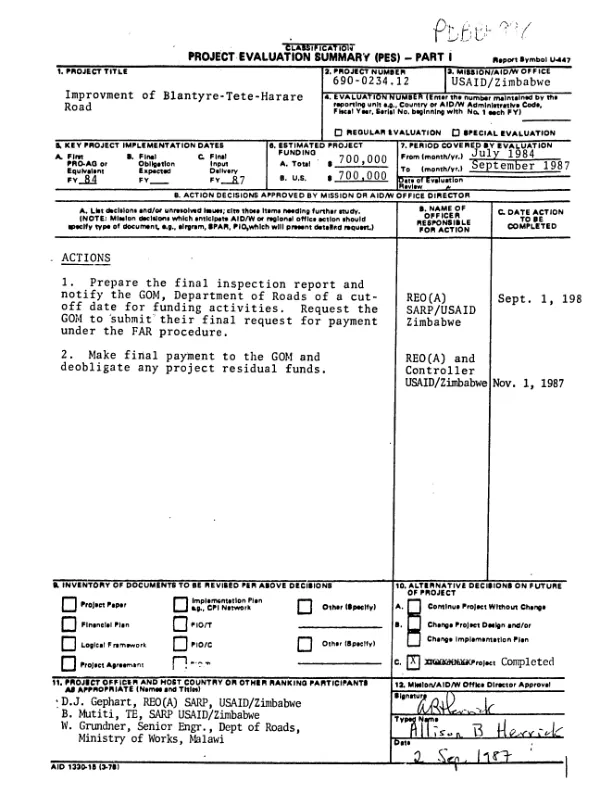
Improvement of Blantyre - Tete - Harare road
Evaluates project to improve and maintain 80 km in Malawi of the (unpaved) Blantyre-Tete-Harare Road, a key transport link among the majority-ruled nations of Southern Africa.
Gephart, D. J.; Mutiti, B. · 1987
Sign in to readA free account is required to download.
Abstract
Final PES covers the period 7/84-9/87 and is based on document review, site inspection, and interviews with project, Government of Malawi, and Mission officials. The project more than fulfilled its objectives, although an extension was necessitated by delays in completing a parallel highway funded by the European Economic Community (EEC). Project improvements in a 62-km section of dirt road near Mwanza between Blantyre and the Mozambique border have yielded yearly increases in goods transported and large decreases in travel time. The quality and progress of the work was exceptionally good, and the final cost of $12,000 per km is in line with the costs of other road improvement efforts in Southern Africa. Project activities included rebuilding and reshaping various road segments and gravelling hilly sections in a manner which, with continual maintenance, would permit travel of 4- and 6-axle vehicles, even in the rainy season. With the opening of the parallel road for heavy truck traffic, the dirt road has become part of the local secondary feeder system. The project provides lessons, particularly for the planned Karonga-Songue road project, also in Malawi. Among these are: (1) external factors (in this case, the delay in completing the EEC-funded road) can control project funding amounts and timeframes; (2) fixed amount reimbursement was much more efficient than unit cost reimbursement; (3) host country regulations may negate the possibility of directly providing foreign exchange (for procurement) to a host government implementing agency; (4) maintenance costs on an unpaved roadway carrying 4- and 6-axle trucks, can quickly become uneconomical, especially under rainy conditions - one accident can cause damage equivalent to the cost of surface gravelling.