USAID DEC
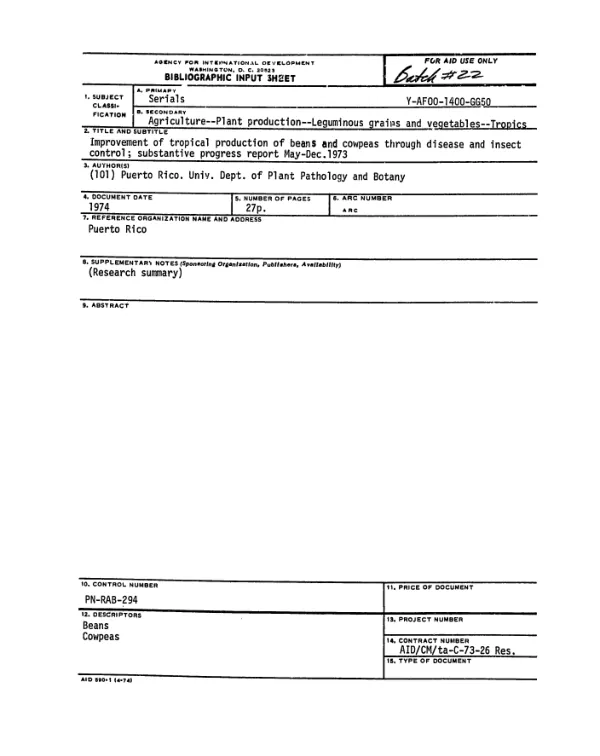
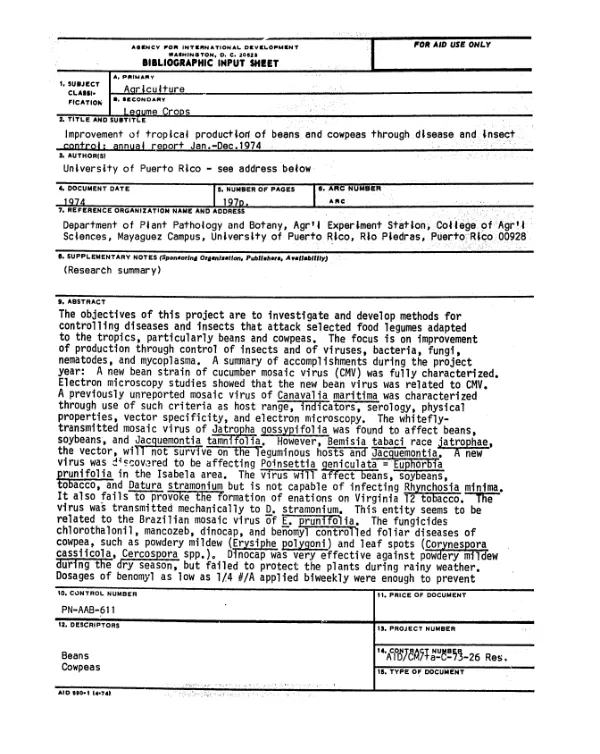
Improvement of tropical production of beans and cowpeas through disease and insect control; annual report Jan.-Dec. 1974
Sign inUNIVERSITY OF PUERTO RICO AT SAN JUAN. DEPT. OF PLANT PATHOLOGY AND BOTANY
Improvement of tropical production of beans and cowpeas through disease and insect control; annual report Jan.-Dec. 1974
The objectives of this project are to investigate and develop methods for controlling diseases and insects that attack selected food legumes adapted to the tropics, particularly beans and cowpeas.
1970
Sign in to readA free account is required to download.
Abstract
The focus is on improvement of production through control of insects and of viruses, bacteria, fungi, nematodes, and mycoplasma. A summary of accomplishments during the project year: A new bean strain of cucumber mosaic virus (CMV) was fully characterized. Electron microscopy studies showed that the new bean virus was related to CMV. A previously unreported mosaic virus of Canavalia maritima was characterized through use of such criteria as host range, indicators, serology, physical properties, vector specificity, and electron microscopy. The whitefly-transmitted mosaic virus of Jatropha gossypifolia was found to affect beans, soybeans, and Jacquemontia tamnifolia. However, Bemisia tabaci race jatrophae, the vector, will not survive on the leguminous hosts and Jacquemontia. A new virus was discovered to be affecting Poinsettia geniculata = Euphorbia prunifolia in the Isabela area. The virus will affect beans, soybeans, tobacco, and Datura stramonium but is not capable of infecting Rhynchosia minima. It also fails to provoke the formation of enations on Virginia 12 tobacco. The virus was transmitted mechanically to D. stramonium. This entity seems to be related to the Brazilian mosaic virus of E. prunifolia. The fungicides chlorothalonil, mancozeb, dinocap, and benomyl controlled foliar diseases of cowpea, such as powdery mildew (Erysiphe polygoni) and leaf spots (Corynespora cassiicola, Cercospora spp.). Dinocap was very effective against powdery mildew during the dry season, but failed to protect the plants during rainy weather. Dosages of benomyl as low as 1/4 #/A applied biweekly were enough to prevent infection by E. polygoni, C. cassiicola, and Cercospora spp. Both basic copper sulfate and copper hydroxide at the rate of 1 #/A controlled common bacterial blight of beans Xanthomonas phaseoli). Bean rust Uromyces appendiculatus) was controlled by mancozeb, Plantvax, and Triforine at 1 #/A. The last two fungicides are systematic and were applied every 14 days. Isolates of Xanthomonas phaseoli var. fuscans when inoculated to cowpeas and beans very frequently lost their capacity to produce pigment. Soil and root samples taken to determine the nematodes associated with beans and cowpeas indicated the presence of several known and suspected plant-parasitic species. The most common genera found were Rotylenchulus, Helicotylenchus, Meloidogyne, Pratylenchus, Tylenchus, Aphelenchus, and Aphelenchoides. Field tests on the use of promising insecticides with beans and cowpeas were conducted, but no conclusive results were obtained, sometimes because of low insect infestations, and on other occasions, because of heavy rains after applications.