INTERNATIONAL RESCUE COMMITTEE
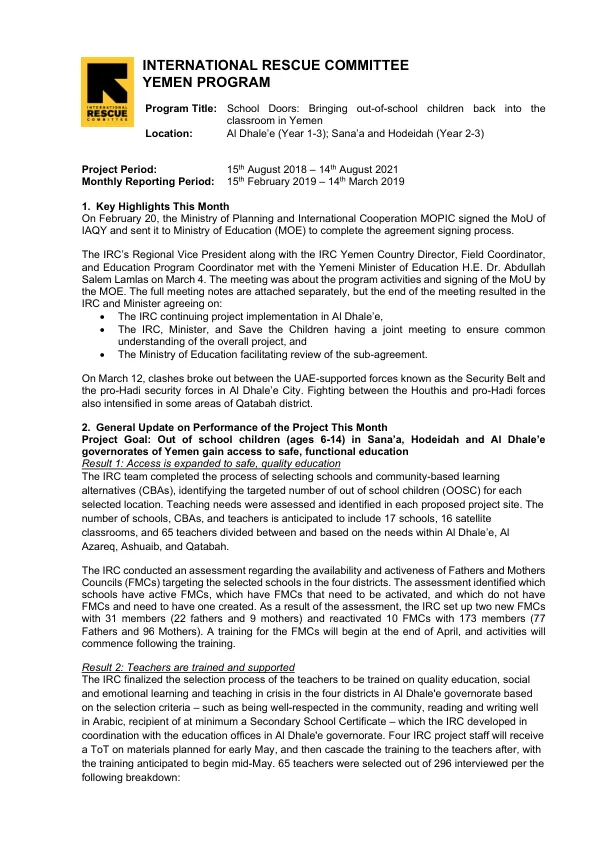
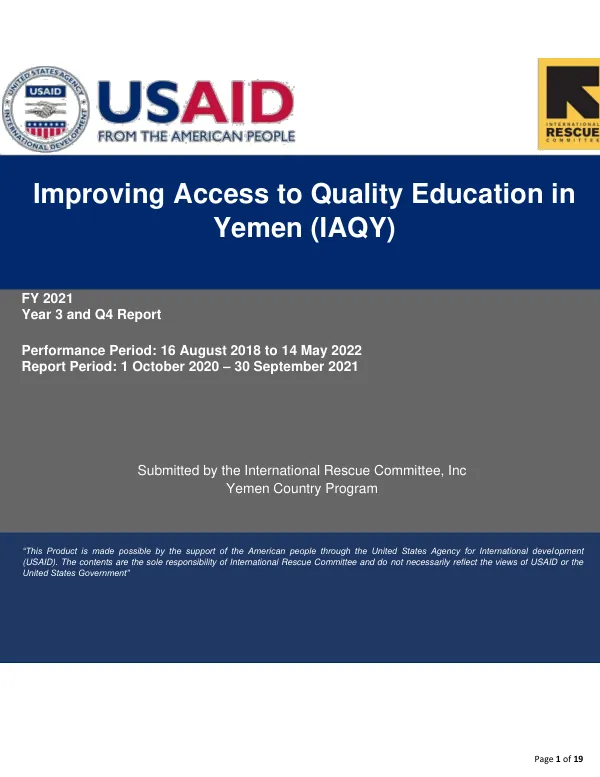
Improving Access to Quality Education in Yemen (IAQY) FY 2021 Year 3 and Q4 Report
Improving Access to Quality Education in Yemen (IAQY) began in 2018 with funding from the United States Agency for International Development (USAID).
2021 · 19 pages
Sign in to readA free account is required to download.
Abstract
The initiative aimed to restore and improve access to quality education in five districts of Al Dhale'e governorate, namely Al Azareq, Al Hussein, Al Shuayb, Qa'atabah, and Al Dhale'e. The project focused on supporting learners aged 6 to 14, with a cumulative 12,999 learners supported across the governorate. During 2021, the humanitarian situation in Yemen was exacerbated by conflict, economic blockade, COVID-19, heavy rains, and flooding. The main roads connecting Aden and Sana'a passed through Al Dhale'e governorate, leading to humanitarian aid, commercial traffic, and civilians diverting onto long and dangerous mountain roads. Torrential rains and widespread flooding damaged infrastructure and destroyed homes and shelters across Al Dhale'e governorate. Implementation of the IAQY project involved strategic engagement with stakeholders from the national Ministry of Education (MoE) level to individual parents. This engagement strengthened participation, transparency, and accountability in working toward a shared goal of returning children to school in the targeted locations. To increase access to learning, IRC established alternative learning spaces in or near IDP camp settings in collaboration with stakeholders. A back-to-school campaign was organized in September to encourage parents and caregivers to send their children to start the new school year. By this month, IRC established Father and Mother Councils (FMCs) in all 42 schools and linked Community-Based Centers (CBCs) with a minimum of 12 members. The FMCs formalized a way for parents and caregivers to connect with school administrators on important issues and activities related to their children's education. IRC produced and distributed 11,140 Teaching and Learning Materials (TLM) to schools in September. The materials included Accelerated Learning Program (ALP) materials for Arabic, Math, and Science, Basic Literacy and Numeracy (BLN) materials, and Safe Healing Learning Spaces (SHLS) materials. IRC also conducted six trainings of trainers (ToTs) on topics such as Teachers in Crisis Context (TiCC) and Social Emotional Learning (SEL). To address the risks of COVID-19, IRC procured face masks, hand sanitizer, and handwashing soap, which were distributed to schools and CBCs to curb the spread of the virus. Community awareness emphasized COVID-19 prevention through handwashing, proper use of face masks, and limiting handshaking. Schools were closed in April to September for annual long holidays, during which IRC conducted summer remedial classes for 5,758 learners in grades 1 to 4. Regular monitoring was conducted to ensure that data collected and reported was accurate. This included monthly indicator verifications, updating IRC's Indicator Tracking Tool to align to the revised M&E plan, and activity verification exercises. The Terms of Reference and data collection tools for the baseline survey have been developed, and preparations are now at an advanced stage. IRC received 183 pieces of feedback from beneficiaries and community members on the project during the reporting period. Feedback was received through multiple channels, including a helpdesk, office walk-ins, phone calls, SMS, a suggestion box, and WhatsApp. The majority of feedback received fell into the 'request for assistance' category, with 63% of the feedback received.
Related documents