USAID DEC
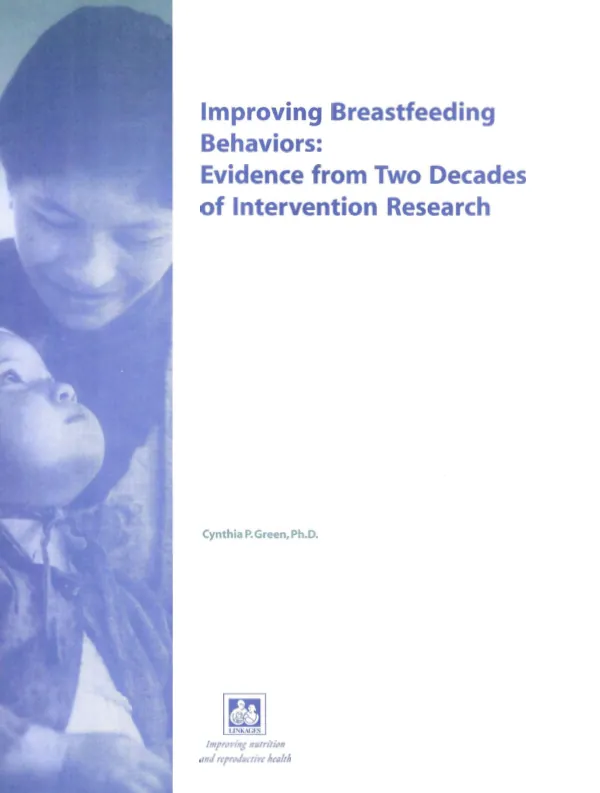
Improving breastfeeding behaviors : evidence from two decades of intervention research
Sign inACADEMY FOR EDUCATIONAL DEVELOPMENT, INC. (AED)
Improving breastfeeding behaviors : evidence from two decades of intervention research
This report presents findings from 51 studies on the impact of various interventions on the early initiation of breastfeeding, the feeding of colostrum, and exclusive and continued breastfeeding.
Green, Cynthia P. · 1999
Sign in to readA free account is required to download.
Abstract
Brief summaries of the studies, which varied widely in methodology, are published separately (PN-ACH- 558). Only one study, on a program in Kenya to promote breastfeeding in hospitals and to train health workers in breastfeeding promotion and lactation management, examined the impact of national policy changes. Though no definitive conclusion can be drawn, after the program, hospital policymakers and maternity ward staff were more knowledgeable about breastfeeding, and their practices improved dramatically. Few studies focused on the impact of prenatal education in isolation, but some results suggest that prenatal education, when combined with other interventions, such as training of health providers, changes in hospital policies to allow early breastfeeding and contact with the newborn, and access to an outpatient breastfeeding support clinic, are associated with improved breastfeeding practices. One study found that mothers in their last 3 months of pregnancy who had access to health promoters had higher rates of exclusive breastfeeding at 1, 4, and 6 months postpartum. Other studies suggest that the same results can be obtained by distributing educational pamphlets. Still other studies pointed to no impact. Numerous well-executed studies documented the impact of changing hospital practices. On the whole, these studies suggest that: counseling (especially individual counseling) and discharge packs supportive of breastfeeding can have a dramatic and positive effect on exclusive breastfeeding rates, as can training of hospital staff in lactation management; post-partum home visits can extend the period of exclusive breastfeeding; and changes in hospital practices influence early breastfeeding behavior but are less likely to have a long-term impact. Other, less rigorous studies suggest that: in-service training of hospital staff in lactation management (in combination with other interventions) is at least modestly associated with early initiation of breastfeeding and the giving of colostrum; initial contact with the mother is associated with better suckling; early initiation and frequent feeding lead to longer breastfeeding duration; and early education of mothers can increase the early initiation of breastfeeding. No rigorously conducted study singled out mass media for its impact on breastfeeding practices. A majority of studies lend credence to the notion that peer counseling and social support in general have a positive effect on the initiation of breastfeeding, giving colostrum, and exclusive breastfeeding. In particular, home visits appear to play a critical role in supporting women"s breastfeeding behaviors and have been associated with longer durations of exclusive breastfeeding. In general, mothers visited more frequently are more likely to adopt recommended behaviors than those visited less often or not at all. The relative cost of attaining improved outcomes has not been assessed. In one setting, trained peer counselors did as well as health workers in educating mothers in this area due to their ability to establish good rapport and trust, their proximity and availability to discuss problems, and frequent contact. However, volunteers need supervision and monitoring to ensure that they are completing their assigned tasks and are providing appropriate information and guidance. Surprisingly little research has been conducted on the impact of women"s support groups. A study in Ghana strongly suggests that women who participate in "Credit with Education" groups are more likely to give colostrum than are non- participating women from the same or comparison communities. Mean age at introduction of water and watery foods is also significantly later among participating mothers. Evidence of the impact of postpartum counseling and guidance by health workers is mixed. In one study, counseling and referrals by volunteer advocates did not increase the prevalence or duration of exclusive breastfeeding. In another, individual counseling and monthly clinical support collectively contributed to higher rates of exclusive breastfeeding at 6 months postpartum. Contains bibliography.