USAID DEC
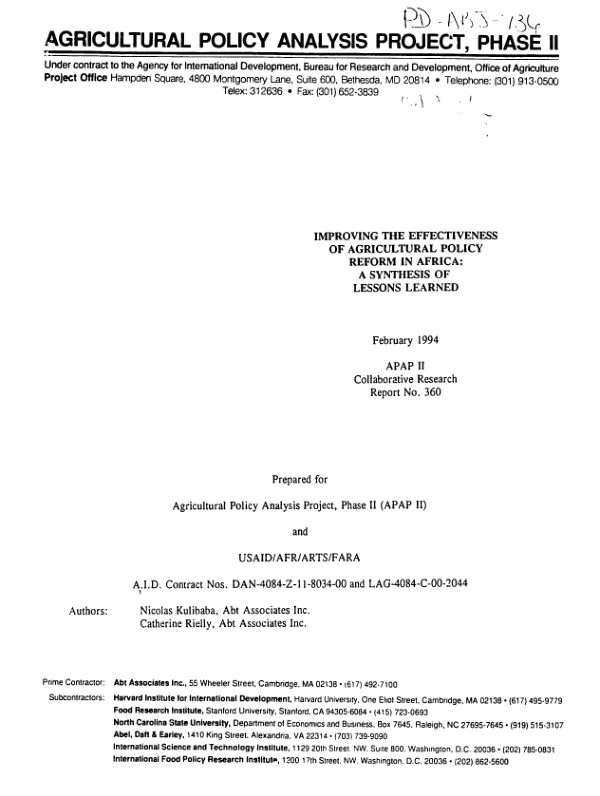
Improving the effectiveness of agricultural policy reform in Africa : a synthesis of lessons learned
Sign inABT ASSOCIATES, INC.
Improving the effectiveness of agricultural policy reform in Africa : a synthesis of lessons learned
Lessons learned from a project to support agricultural policy reform in Africa are synthesized in this study.
Kulibaba, Nicolas; Rielly, Catherine · 1994
Sign in to readA free account is required to download.
Abstract
A review of project efforts in Cameroon, Cote d"Ivoire, Ghana, Madagascar, Mali, Malawi, and Zambia resulted in lessons under four headings. Analysis, Strategy, and Tactics. (1) While economic analysis is the basis for the design of agricultural marketing reforms, political analysis is crucial to assessing the prospects of reform success and developing appropriate implementation strategies. (2) Seizing political opportunity can be crucial to the successful initiation of reforms. (3) Risks of failure are heightened when policy reform results in the displacement of entrenched political patronage systems and the suppression of politically driven rents. (4) "Sweeteners" -- strategies designed to defuse or co-opt opposition through compensation -- raise the cost, but lower the political risk of reform failure. Initiation. (1) Political leaders" control over bureaucratic appointments and government structures gives them enormous power to mobilize elite support behind reform and to distance reform opponents. (2) It is essential that donors build consensus among themselves before negotiating with the host government. (3) Foreign technical advisors play an important role in identifying and establishing support for host country policy champions. (4) Close donor contact with host country technocrats leads to more successful implementation. Implementation. (1) Policymakers" lack of understanding of market reform and weak intellectual commitment to liberalization inhibits implementation. (2) Reform is most likely to succeed when implemented by a strong and committed central authority. (3) Donor conditionality is an imperfect tool in reform implementation. (4) Complementary public policies that strengthen the environment in which rural markets operate improve implementation capacity. (5) Contingency planning should be a key element of implementation strategy. Sustaining Reform. (1) It is not sufficient to assume that political support will coalesce among the beneficiaries of reform. Policymakers and political leaders must work to mobilize stakeholders to promote and defend the reform process. (2) Donor commitment to supporting reform should extend to the medium term. (Author abstract, modified)
Related documents