USAID DEC
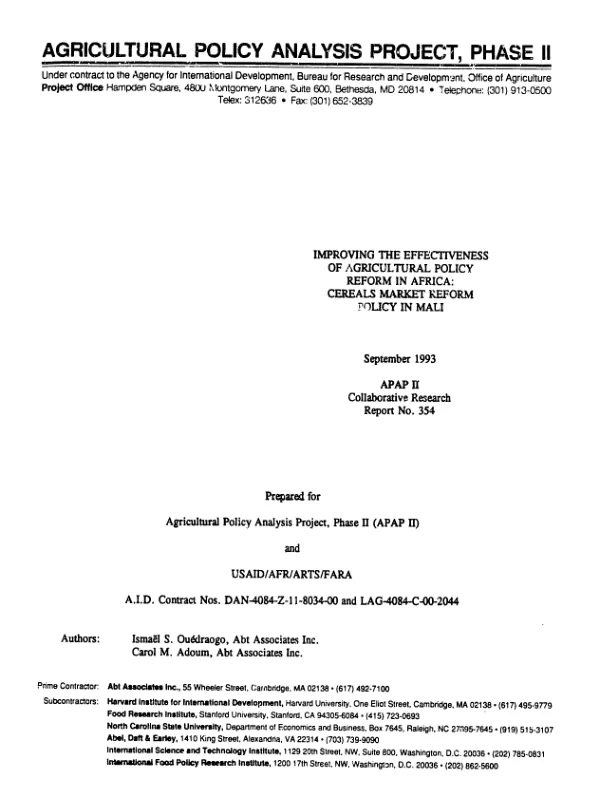
Improving the effectiveness of agricultural policy reform in Africa : cereals market reform policy in Mali
Sign inABT ASSOCIATES, INC.
Improving the effectiveness of agricultural policy reform in Africa : cereals market reform policy in Mali
The multidonor-supported restructuring of the cereals market in Mali, the Programme de Restructuration du Marche Cerealier (PRMC), is widely perceived as a success story -- an oddity in most of sub-Saharan Africa.
Ouedraogo, Ismael S.; Adoum, Carol M. · 1993
Sign in to readA free account is required to download.
Abstract
This field-based case study focuses on the process of PRMC"s policy design and implementation. PRMC was selected for study because of its many unusual features -- it is a rare example of donor coordination in policy features, it spans more than 13 years (mostly under a dictatorial regime, although it also outlasted this regime), and it preceded the World Bank-led Structural Adjustment Program in Mali (although it became part of the SAP). PRMC began in 12/80. when a group of donors (World Bank, Canada, the EEC, FAO, France, the World Food Programme, Germany, and the United States, soon to be joined by Austria, Belgium, the Netherlands, Switzerland, and the United Kingdom) proposed assistance for restructuring of Mali"s cereals markets, supported by a pledge of 250,000 maize-equivalent tons of food aid over 5 years, which was to be sold in Mali to create a counterpart fund to support PRMC"s policy reforms: market liberalization (participation of the private sector in agricultural marketing); pricing policy (prices to be determined by the market); and reorganization of parastatals. PRMC has included several phases: PRMC I, 1981-86 (1981/82 and 1985/86 marketing seasons); Transitional Phase, 1986-87); PRMC II, 1987-90; PRMC III, 1990-93; and a proposed PRMC IV. This study analyzes five key elements of the reform process: the political and sociocultural environment; the role of host country leadership (both political and technical) in agricultural policy reform; the political impact of TA and strategies for maximizing the effectiveness of TA; institutional change strategies and tactics; and interest articulation. Chapters in the study: (1) provide background on PRMC; (2) analyze the phases of PRMC"s market liberalization, pricing, and parastatal reorganization reforms, discussing four major political themes for each phase (coalitions and mass political pressure; donor-government relation; political elite and factions; and bureaucratic interaction); and (3) present conclusions on the four political themes, a discussion of successful and unsuccessful elements of the political process, and an assessment of the impact of political change on reform. (Author abstract, modified)
![Impact of APRP [agricultural policy reform program] at the farm level](https://covers.devme.ai/gen/44055.webp)