USAID DEC
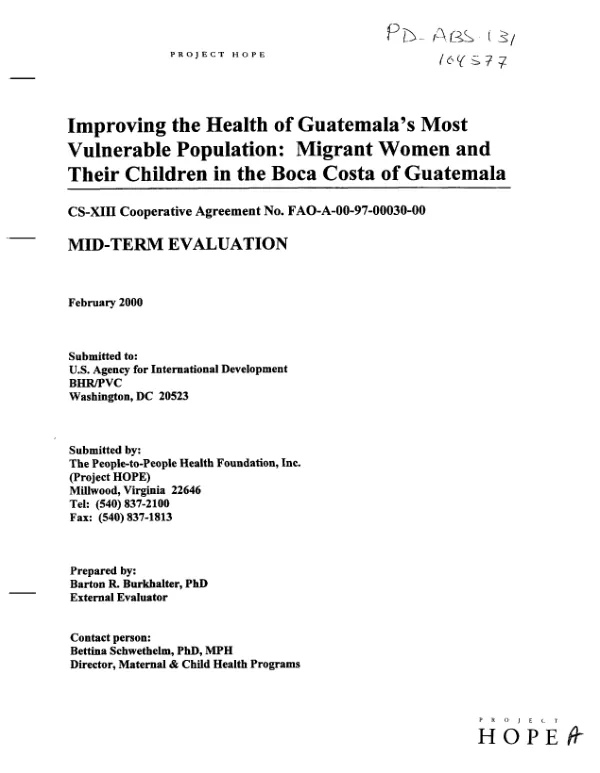
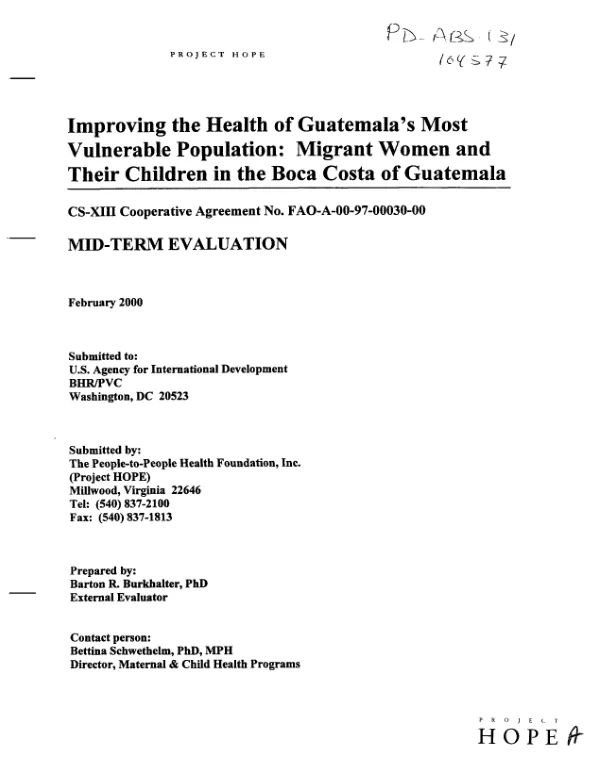
Improving the health of Guatemala's most vulnerable population : migrant women and their children in the Boca Coast of Guatemala : CS-XIII cooperative agreement no. FAO-A-00-97-00030-00 -- mid-term evaluation
Sign inPEOPLE-TO-PEOPLE HEALTH FOUNDATION, INC. PROJECT HOPE
Improving the health of Guatemala's most vulnerable population : migrant women and their children in the Boca Coast of Guatemala : CS-XIII cooperative agreement no. FAO-A-00-97-00030-00 -- mid-term evaluation
Evaluates project to improve the health of migrant families (especially mothers and children) working on coffee estates in five departments of Guatemala.
Burkhalter, Barton R. · 2000
Sign in to readA free account is required to download.
Abstract
Interim evaluation covers the period 1997-12/99. Project HOPE is the implementing agency. The project strategy is to promote collaboration among the coffee estates, Ministry of Health (MOH) offices, Social Security hospitals and health services, and health centers operated by Anacafe (the association of coffee growers) in finding sustainable solutions to the health problems faced by the target population, which is comprised of indigenous peoples. This is a risky venture, and includes at least three cutting-edge issues: working with migrants, who provide a very small window of opportunity; working with many different indigenous cultures; and working with the commercial enterprises that employ these people. Also challenging is the sheer number of partner organizations, which include 150-200 different coffee estates, three MOH departmental offices (each with an array of district offices and health centers), the Social Security, and NGOs. The project has met or exceeded most of its scheduled targets to date. It has trained 197 staff from partner health organizations, 473 volunteer health promoters, and 667 traditional midwives in case management and information, education, and communication (IEC), reflecting 83%, 124% and 102%, respectively, of target. It has convinced 130 coffee estates to join the program; created a series of audio tapes on various common illnesses in Spanish and two Indian languages for broadcasting on radio stations and from the health posts at numerous coffee estates; and gained the full support of the top management of the departmental MOH and Social Security offices. Significant improvements in health services are apparent, as evidenced by increases in vaccination coverage and prenatal visits. Project HOPE is performing very competently, and has a well-functioning financial information system, a project achievement monitoring system, a personalized but systematic effort of contact and communication with the many partner organizations, and the beginning of a set of mini-studies of particular issues. Key persons from the Ministry, Social Security, and the estates expressed high regard for Project HOPE's technical know-how and professionalism. The capacity, personality, and long-term relationships of the Project Director is an important element in its credibility. When asked why they committed resources to the program, estate owners and managers generally responded that it was (1) the right thing to do and (2) would increase the long- term stability of their work force and productivity of the enterprise. None seemed to think it would increase short-term profits. Other key factors included the credibility of Project HOPE in health care, and the fact that the cost to the estates was not very high. Supplying medications is a major problem. For example, in some estates medicines are available for children but not for adults, and the relative financial contributions of patients, estates, and the MOH to the costs of medicines differ widely from place to place. Project HOPE has begun to address this problem by establishing a local NGO which has since been contracted by the MOH to acquire and distribute the needed medicines in a rational fashion. Other problems include the quality of care being provided by the health workers and the effect on the MOH of the change in government administration that is likely to occur in the near future. Also, little or no attention has been given to child spacing or family planning. Finally, continued focus needs to be given to arranging sustaining funding for the program. In sum, the project appears on the road to a resounding success. It may well become a model for Guatemala and internationally as well. Steps should be taken now to make this possible, e.g., by focusing more attention on the final evaluation than is usually done with PVO child survival grants. Project HOPE may want to analyze the cost implications of the program on the budgets of coffee estates of different types.
Related documents
Documents in this collection
 2000
2000USAID DEC
Improving the health of Guatemala"s most vulnerable population : migrant women and their children in the Boca Coast of Guatemala : CS-XIII cooperative agreement no. FAO-A-00-97-00030-00 -- mid-term evaluation
Open record 1993
1993USAID DEC
![Extending successful hospital-based child survival strategies into surrounding urban, peri-urban, and rural communities of Boaco, Nicragua : CS-VII [child survival], grant no. PDC-0500-G-00-1064-00 -- final evaluation, September 1991-February 1995](https://covers.devme.ai/gen/5755.webp)