USAID DEC
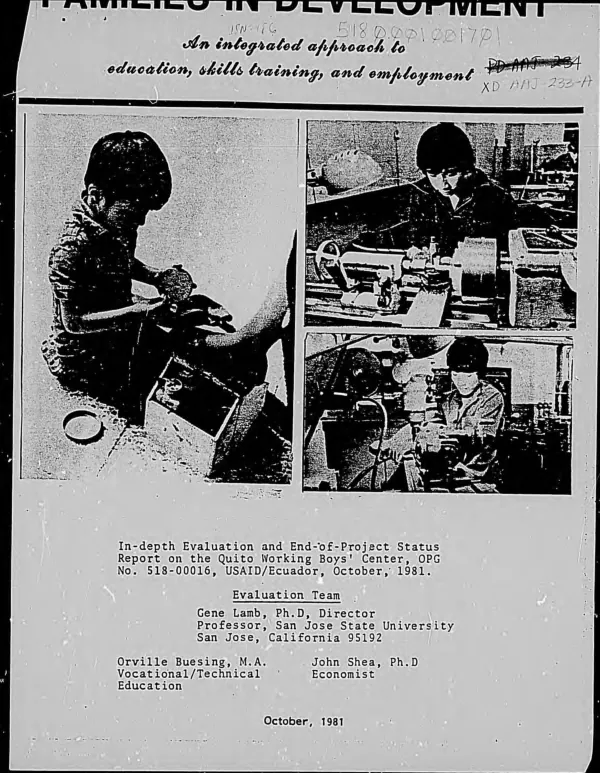
In-depth evaluation and end of project status report on the Quito Working Boys' Center
Sign inUSAID DEC
In-depth evaluation and end of project status report on the Quito Working Boys' Center
Evaluates project to expand the capacity of the Quito Working Boys' Center (QWBC) in Ecuador to provide income-generating vocational training.
Lamb, Gene|Buesing, Orville|Shea, John · 1981
Sign in to readA free account is required to download.
Abstract
Special evaluation covers the period 12/78-7/81 and is based on site visits and interviews with QWBC staff and with trainees and their families. There has been a notable shortfall in meeting trainee targets, with only 30 of 90 and 9 of 30 boy trainees employed, respectively, outside and inside QWBC; 17 of 100 trainee mothers employed at QWBC; and 62 of 150 trainee sisters completing the Corte y Confeccion program. The job placement and follow-up program, still informal, has been only a nominal success. In a sense, these shortfalls have been outweighed by successes in building up QWBC's institutional capacity; e.g., by the development as planned of market studies and, of a QWBC sales department which increased 1981 monthly on-property wages by 75%. Two key issues, however, render future USAID/P support to QWBC doubtful: low enrollment (only 15-20% of all eligible youth) and high drop-out rates. These are due, according to the evaluation team, to the fact that QWBC's program is open only to entire families and especially to the rigorous code of behavior (Regalamento" required of all participants. It is recommended that QWBC make its "Regalamento" an ideal to work towards within a family counselling context rather than an absolute daily requirement; make instruction student/family rather than teacher-centered; develop a formal recruitment program; and consider decentralizing some activities to distant community-based schools, churches, homes, or businesses. To increase the number of female participants, it is recommended that QWBC hire a women's development specialist to expand women's programs (11 possible course areas are suggested); add courses in consumer education, foods and nutrition, family relations, and child development in the pre-vocational program; and consider co-educational courses. QWBC should also hire a person with vocational training experience to help develop the instructional programs and improve its procedures for assessing and reporting program status -- especially when making major changes such as expanding the total course from 2 to 3 years.