USAID DEC
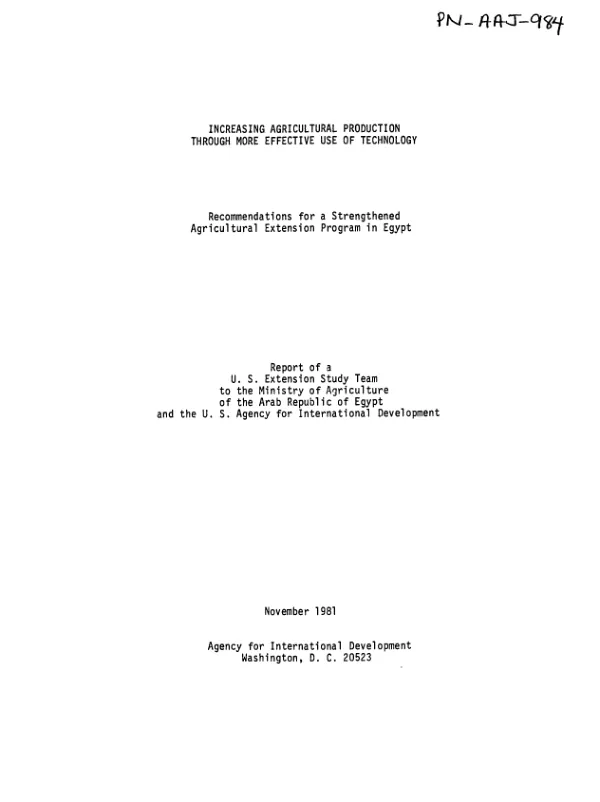
Increasing agricultural production through more effective use of technology : recommendations for a strengthened agricultural extension program in Egypt
Sign inUSAID. MISSION TO EGYPT
Increasing agricultural production through more effective use of technology : recommendations for a strengthened agricultural extension program in Egypt
Current technology could significantly increase Egypt"s agricultural productivity and provide more food for the country"s population, which will double in the next 20 years.
Firebaugh, F. M.; Kiehl, E. R. · 1970
Sign in to readA free account is required to download.
Abstract
Against a background description of Egypt"s agricultural needs and potential, this report presents the findings and recommendations of a U.S. team which reviewed Egypt"s agricultural research and extension (ARE) programs. The team found that: (1) Despite the rich land, water and climate of Egypt"s Nile Valley and Delta (which accounts for only 3.5% of the country), arable land is limited. (2) Because land reclamation is costly and has a limited net impact on agricultural productivity, increasing agricultural productivity depends on increased Government of Egypt (GOE) investment in improved technology. (3) Weak and uncoordinated ARE programs and obsolete GOE policies such as compulsory plantings and fixed prices for commodities delivered to the GOP are the main constraints to higher agricultural productivity. (4) A.I.D."s agricultural productivity projects are not adequately integrated into Egyptian ARE institutions and 13 university faculties of agriculture and numerous agricultural professionals are not effectively involved in national ARE activities. (5) Productivity of rural Egyptians, especially women, will increase along with improved technology. Based on these conclusions, the team recommends that the GOE: (1) create a single ARE unit to provide a link between the research and extension functions, along with a Technical Support Division of Extension composed of trained specialists working closely with their research counterparts; (2) integrate agricultural colleges into national ARE activities; (3) provide continuing education and incentive programs for extensionists; (4) establish clear and direct lines of authority and communication between the national- and village-level extension services; (5) ensure that extensionists pay special attention to the needs of rural families and women; and (6) update its agricultural policies and agencies. The team also recommended that A.I.D. integrate its current projects into recommended ARE program design and that a joint Egyptian/U.S. team annually review the progress of the program. Appended are two annexes and a bibliography (1977-81).