USAID DEC
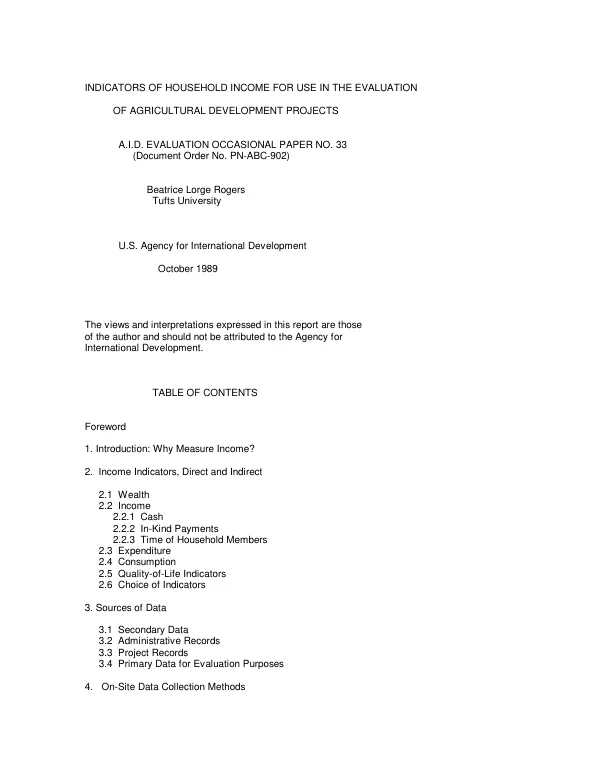
Indicators of household income for use in the evaluation of agricultural development projects
Sign inUSAID. BUR. FOR PROGRAM AND POLICY COORDINATION. CENTER FOR DEVELOPMENT INFORMATION AND EVALUATION (CDIE)
Indicators of household income for use in the evaluation of agricultural development projects
Changes in the amount of household income as well as in the form, timing, and flow of income are important in measuring the effectiveness of agricultural interventions.
Rogers, Beatrice Lorge · 1989
Sign in to readA free account is required to download.
Abstract
Household income is difficult to assess, however, due to problems in selecting an appropriate reference period, the possibility of severe income fluctuations in the short term, and, in some settings, the reluctance of people to discuss their income. This report examines selected income indicators, including wealth and asset ownership, in kind and cash income, home labor and its monetary value, expenditures, consumption, and quality of life indicators (i.e., nutritional status and infant and child mortality). Various data sources for measuring income are then described, including secondary data, administrative records, project records, and primary data for evaluation purposes. According to the report, a reliable evaluation is likely to require primary data collection, since secondary sources are unlikely to provide the necessary level of detail. The final section of the report summarizes onsite data collection methods, including direct observation, focus groups, key informant interviews, and small- scale surveys. The report recommends frequent, small-scale evaluations to generate data for use in program modification. Appended is a lengthy excerpt from a questionnaire from a food consumption survey conduucted in the Dominican Republic which exemplifies different approaches to estimating household income.
Connected topics