USAID DEC
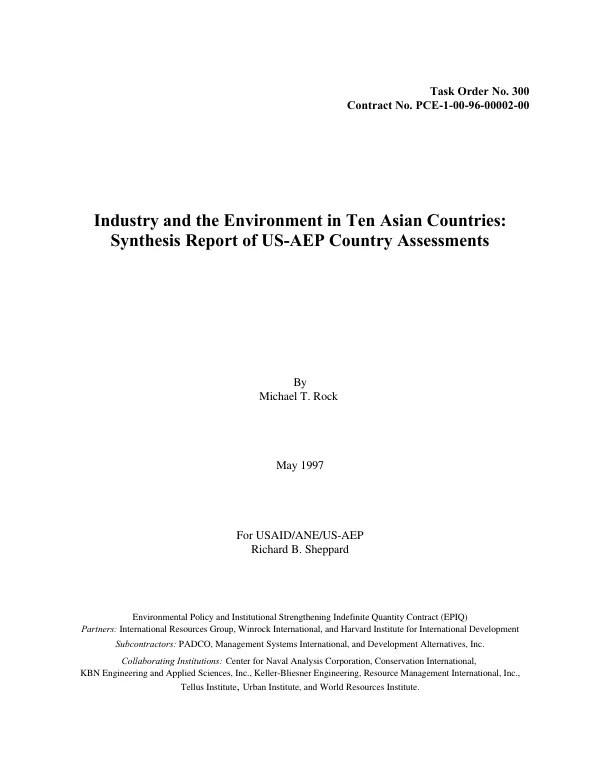
Industry and the environment in ten Asian countries : synthesis report of US-AEP country assessments
Sign inHARVARD UNIVERSITY. HARVARD INSTITUTE FOR INTERNATIONAL DEVELOPMENT (HIID)
Industry and the environment in ten Asian countries : synthesis report of US-AEP country assessments
To help the U.S.-Asia Environmental Partnership (US-AEP) combat the severe environmental degradation that has accompanied high-growth economic development in Asia"s newly industrializing economies (NICs), a multidisciplinary team examined industry-environment interactions in 10 Asian countries: four first-tier NICS (Hong Kong, Singapore, South Korea, and Taiwan), three second-tier NICs (Indonesia, Malaysia, and Thailand), and three historically slower growers (India, the Philippines, and Sri Lanka).
Rock, Michael T. · 1997
Sign in to readA free account is required to download.
Abstract
The study used in-depth interviews and literature reviews to identify and assess the probable impact of government policies, community and NGO actions, and emerging environmental market pressures on the environmental behavior of polluting manufacturing firms. The study focused on four questions. (1) To what degree are governments and private sectors responding to new international environmental market pressures, such as by green labeling programs, voluntary environmental management standards (such as International Organization for Standardization [ISO] 14000), and multinational corporation environmental practices, such as greening of supplier chains? (2) To what degree are environmental considerations being integrated into the economic and industrial policies and practices of central economic ministries, such as planning agencies, ministries of industry, investment promotion agencies, standards and testing institutes, and science and technology agencies? (3) What role do traditional command and control environmental agencies and ministries play in discouraging pollution and promoting resource-intensive industrial development? How do environmental agencies and ministries relate to and interact with economic and industrial ministries? (4) How do public awareness and community pressures affect the pollution and resource intensity of industrial production? The study revealed that the 10 Asian countries are experiencing a sea change in public and private attitudes toward the environment. Central economic ministries are increasingly investing in environmental programs, environmental ministries are becoming stronger, and NGOs and communities are organizing for a better environment. Taken together, these activities could well be the incubator for what US-AEP terms a "clean industrial revolution." But except for a few cases among the highest income NICs, no consistent policy framework exists to promote a clean industrial revolution. Success will depend heavily on development of an appropriate policy framework in each of the 10 Asian countries. Approaches that US-AEP might encourage to strengthen these frameworks are outlined in conclusion.
![Evaluation of the US-Asia environmental partnership [US-AEP]](https://covers.devme.ai/gen/5422.webp)
![Evaluation of the US-Asia environmental partnership [US-AEP]](https://covers.devme.ai/gen/44258.webp)