USAID DEC
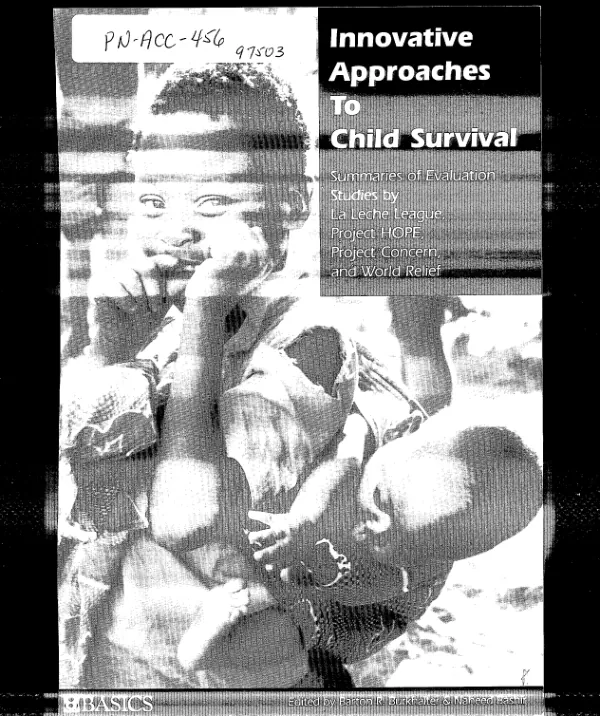
Innovative approaches to child survival : summaries of evaluation studies by La Leche League, Project HOPE, Project Concern, and World Relief
Sign inUSAID DEC
Innovative approaches to child survival : summaries of evaluation studies by La Leche League, Project HOPE, Project Concern, and World Relief
Innovative child survival (CS) interventions are documented in this summary of evaluations of CS efforts by four PVOs -- La Leche League, Project HOPE, Project Concern, and World Relief.
Burkhalter, Barton R., ed.; Bashir, Naheed, ed. · 1970
Sign in to readA free account is required to download.

Abstract
Many of the findings are unexpected. Project HOPE believed that tea estates in Malawi had supported a maternal and child health program for workers and their families to increase worker productivity or reduce medical costs, but found that estate managers felt that the marginal out-of-pocket cost was very low and that such a program was the right thing to do; they also trusted Project HOPE to manage the activity in a way that would not be controversial and not place undue burden on estate managers. La Leche League trained over 200 volunteer mothers from the poor barrios of Guatemala City to be breastfeeding counselors and then helped them support local mothers in nurturing their children. The League had thought that over half the breastfeeding counselors had dropped out of the program in the 3 years after the grant ended, but discovered that nearly all were still active and were in touch with about 25% of all the women of child-bearing age in the project communities. Equally surprisingly, the intensity and quality of the program had continued unabated for 3 years with no supervision. Instead, a system of mutual support among community mothers, the volunteer counselors, and La Leche League kept the program participants motivated and informed at low cost. In Project Concern International"s immunization program in the Maluku Province of Indonesia, the PVO had no idea how remarkably successful its peer training program had been until a study estimated that immunization coverage increased by 40% in program health centers at a cost of only about 50 cents per additional fully immunized child. A study of the Hearth program at Albert Schweitzer Hospital in Haiti through World Relief Corporation produced several surprising and important findings. To scale up to the district level, the program first had to cut costs by moving the program closer to the communities and using community resources and know-how. The result was an effective network of community health volunteers linking the hospital to households throughout the district. Although designed to rehabilitate severely undernourished children, the program unexpectedly proved more effective at preventing the deterioration of mild and moderately malnourished children. In another unexpected finding, information from "positive-deviant" mothers (i.e., poor mothers with well-nourished children) about what they fed their healthy children proved more valuable as a way of convincing other mothers that they too could afford to feed their children a nourishing meal than as a technique for discovering affordable and nourishing menus. (Author abstract, modified)
Related documents
Documents in this collection
 1997
1997USAID DEC
Innovative approaches to child survival : summaries of evaluation studies by La Leche League, Project HOPE, Project Concern, and World Relief
Open record 2004
2004USAID DEC