USAID DEC
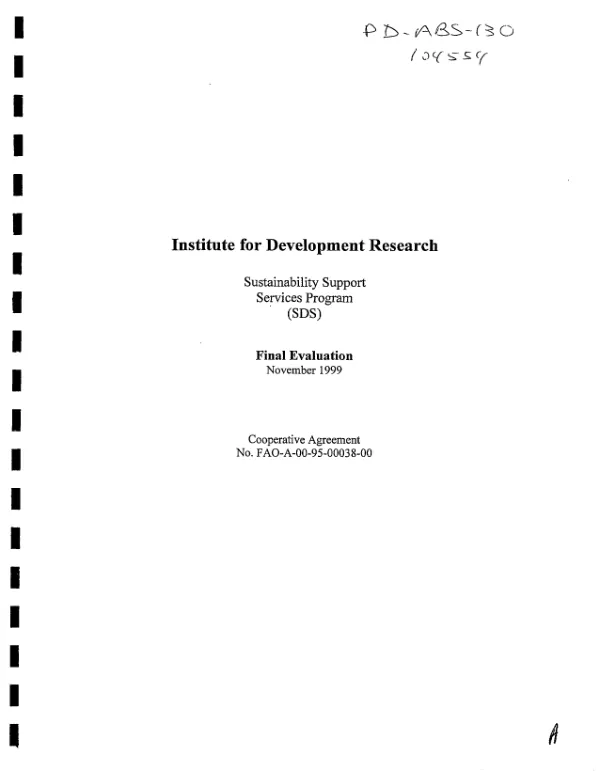
Institute for Development Research : sustainability support services program (SDS) -- final evaluation
Sign inAMA TECHNOLOGIES, INC.
Institute for Development Research : sustainability support services program (SDS) -- final evaluation
Final evaluation of the Sustainable Development Services Project (SDS), designed to build the program and financial capacity of PVO and NGOs.
1999
Sign in to readA free account is required to download.
Abstract
The project was implemented by a consortium composed of the Institute for Development Research, Freedom from Hunger, and Lassen Associates. The evaluation covers the period 1995-11/99 against a PACD of 2/00. The project originally targeted PVOs/NGOs involved in health, nutrition, and population (HNP) programs, but was later expanded to include all interested PVOs/NGOs. Principal findings are as follows: (1) Development of a standard and coherent definition of sustainability was a singular success. (2) Blending theory and practice with the effort to address financial sustainability through a conceptual framework has been a solid achievement. (3) SDS was partly effective in overcoming PVO resistance to the legitimacy of cost-recovery and revenue- generating techniques. (4) Sustained provision of tailored TA was effective in changing attitudes and introducing techniques for change. (5) The two-step approach of workshops and tailored TA proved effective and workable. (6) Reports from participating PVOs show a marked increase in organizational commitment to financial sustainability and related changes at headquarters and in the field. (7) Workshops were professionally managed, encouraged more serious and creative attention to financial sustainability, and generally, though not always, were tailored to participants' needs. (8) Respondents found assistance in business planning effective and useful. (9) The SDS program has strong potential for smaller, emergent NGOs that tend to be open to innovative practices. (10) Client organizations registered some concern regarding inadequate follow-up and lack of trained SDS staff to assist in putting concepts and recommendations into effect. (11) The overall SDS approach to sustainability was sometimes perceived by participants as rigid and doctrinaire, a reaction in part shaped by resistance to the perceived norms implicit in cost-recovery and revenue-generation. Central lessons learned are as follows: (1) Interventions to introduce the concepts and techniques of sustainability can occur at any place within the organization. (2) Comprehensive organizational transformation and fundamental changes in norms and attitudes require the interest and support of leadership. (3) Self-assessment of a PVO's current financial situation can provide a powerful incentive for change and can help overcome concerns about whether moving toward financial sustainability is counter to an organization's mission and values. There is no secret formula for improved financial sustainability. (4) Transition is difficult and takes time and, probably, ongoing mentoring. (5) Microenterprise-based experience provides important insights, but broader models and tools are required, and the effort needs to be sustained for a longer period of time than the 4-year SDS effort. Issues requiring further discussion include: the importance of PVO/NGO financial sustainability; whether to continue the SDS program or something like it; and the role of the Office of Private and Voluntary Cooperation (PVC) in providing management assistance to the voluntary sector both at home and abroad.
Related documents
Documents in this collection
 1999
1999USAID DEC
Institute for Development Research : sustainability support services program (SDS) -- final evaluation
Open record 2000
2000USAID DEC