USAID DEC
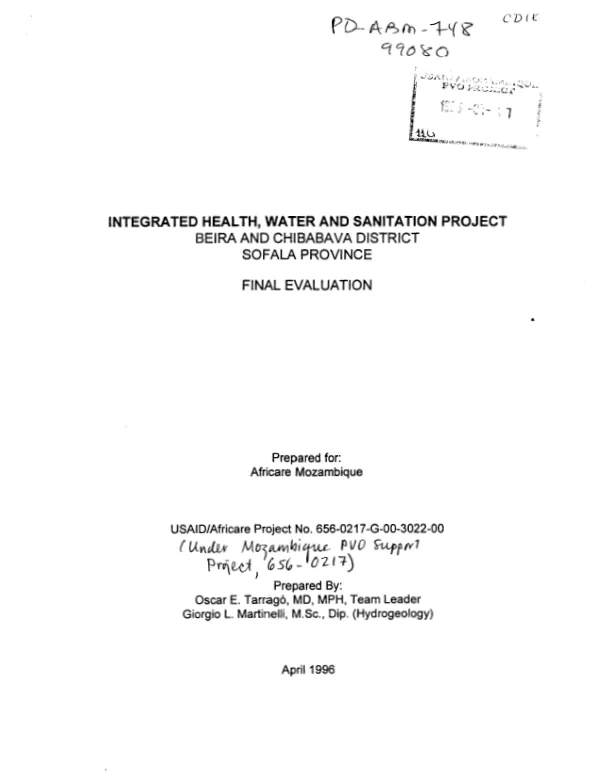
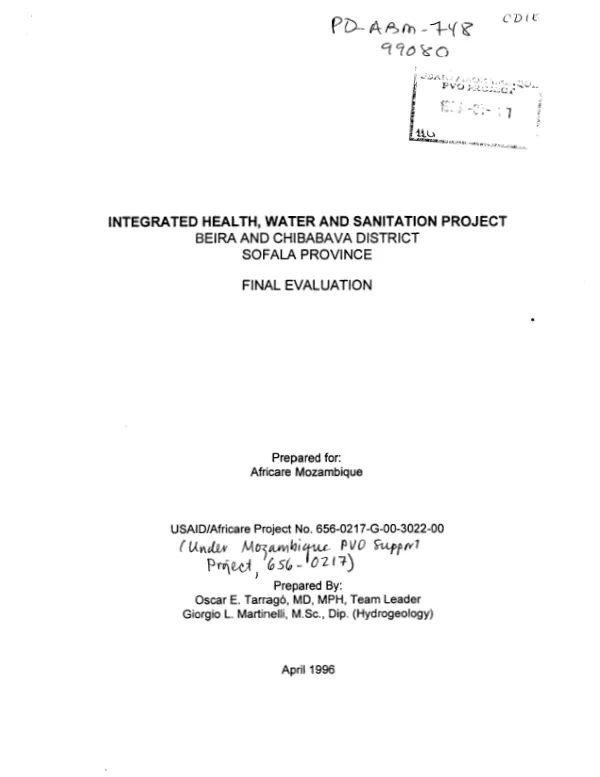
Integrated health, water and sanitation project : Beira and Chibabava District, Sofala Province -- final evaluation
Sign inAFRICARE, INC.
Integrated health, water and sanitation project : Beira and Chibabava District, Sofala Province -- final evaluation
Final evaluation of an OPG to Africare to implement an integrated health, water, and sanitation project in Beira and Chibabava District, Sofala Province, Mozambique.
Tarrago, Oscar E.; Martinelli, Giorgio L. · 1996
Sign in to readA free account is required to download.
Abstract
The evaluation covers the period 9/93-4/96, against a PACD of 6/96. Well rehabilitation, water storage tank construction, latrine construction, and development of a fee system for water points were focused in peri-urban Beira, while health post rehabilitation was targeted at specific rural communities in Chibabava District. Information, education, and communication (IEC) activities have been implemented in both areas. After the mid-term evaluation, the target number of wells and water storage tanks was reduced. The amended targets for facility construction will probably be met, and the construction itself is of high quality, with unit costs kept within acceptable limits. The project"s construction/rehabilitation of 3 health posts in Chibabava District provides the population with access to primary health care. The health impact of well rehabilitation has been very limited, however. Unfavorable geological and hydrogeological conditions, compounded by ubiquitous public defecation around the well sites, means that contaminated water will enter the shallow water table and then the wells, even though they have been properly rehabilitated. Proper use and care of latrines would improve the relationship between water and health. IEC at the community level was also conducted cost-effectively. However, targets for number of people to be reached and activities to be completed were overly ambitious. It is the IEC component that ought to yield the project"s greatest impact -- changes in living conditions, attitudes/practices, quality of life, and health status -- but whether this will be so, can only be known over time. Further, sustainability cannot be guaranteed, since there is no organization to follow up on the project"s activities. The project developed a good relationship with the Technical and Commercial Institute; the involvement of many Institute students in the field during this program augurs well for future projects requiring the construction of wells, tanks, and latrines. The coordination with Programa Latrinas Melhoradas (PLM) also proved productive in increasing the demand and use of latrines. The key recommendation is to identify a sustainable partner organization working in the field (e.g., PLM) to ensure project sustainability. A no-cost extension, re-directing the remaining financial resources towards health education, is also highly recommended. The following lessons were learned. (1) Developing strong relationships with many people and organizations facilitated the work. (2) A lack of knowledge of in-depth technical issues exacerbated problems encountered in the field. Specialized advice should be seen as an investment and sought when dealing with technical issues such as building construction and ground water. Such an investment could have reduced the frustration involved in trying to complete the work and saved valuable limited financial resources. (3) It is important to work with the community in choosing a community strategy. (4) The transfer of technical expertise to the students who were involved and trained is a great contribution to society and provided mutual benefits. (5) Targeted outputs must be feasible, attainable, and realistic if they are to be achieved. (6) Achieving sustainability requires sufficient time for supporting and monitoring an intervention.
Related documents
Documents in this collection
 1996
1996USAID DEC
Integrated health, water and sanitation project : Beira and Chibabava District, Sofala Province -- final evaluation
Open record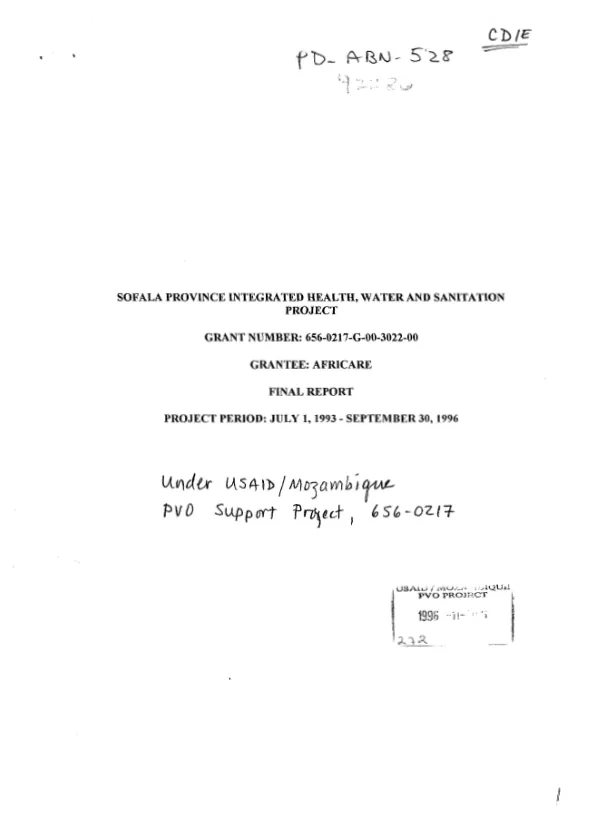 1970
1970USAID DEC
![Community water and sanitation project, Inhambane Province[, Mozambique] : final project evaluation](https://covers.devme.ai/gen/6003.webp)
![Community water and sanitation project, Inhambane Province[, Mozambique] : final project evaluation](https://covers.devme.ai/gen/47801.webp)