USAID. MISSION TO DOMINICAN REPUBLIC
Integrated pest management project (IPM)
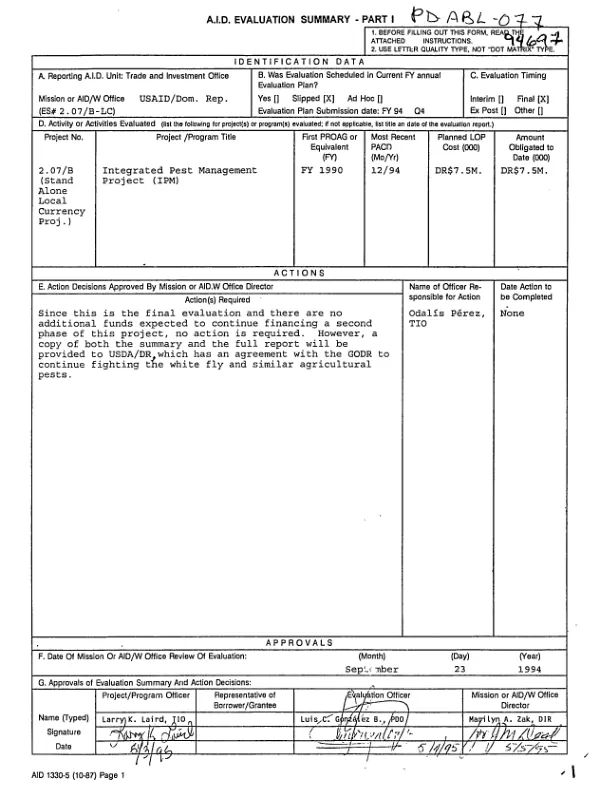
Summarizes final evaluation (PD-ABJ-564) of a project (1990-94) to determine short- and long-term solutions to the serious agricultural pest and pesticide use problems in the Dominican Republic.
1995
Sign in to readA free account is required to download.
Abstract
Despite operating in an adverse and even hostile environment, the project was very successful in reaching and even exceeding its objectives in a relatively short time. By providing answers to complex and baffling crop protection problems and providing cost-effective, environmentally sound integrated pest management (IPM) alternatives, it won respect and support from both the agro-industry community and the public sector. The project conducted helpful research on target pest problems, including two whitefly species, the sweet potato and citrus weevils, the potato tubeworm, the diamondback moth, and the avocado lacebug. The majority (70%) of project resources were devoted to training and extension activities, including field days, demonstration plots, TA, seminars, workshops, and on-farm validation of research results. These activities were highly successful in encouraging the adoption of IPM practices in target areas. Additionally, many producer organizations, as well as individual farmers, found the project a useful forum for raising, discussing, and seeking workable solutions to crop protection problems that previously seemed insoluble. The agribusiness sector"s support for the project is generally very high in each of the four project regions. The project is openly credited by farmers with helping them reduce crop production costs through pesticide reductions. The project also increased awareness of health risks associated with inappropriate and excessive pesticide use, and it helped farmers to better understand the proper role of pesticides in a situation in which a wide selection of pesticides is available to all farmers with little guidance on their use. Lessons learned are as follows. (1) To effectively promote IPM, a project with limited resources must first secure the interest and support of potential beneficiary farmers. It must also address training and extension activities. The dedication and motivation of staff are key considerations. In this project, it helped that many farmers were faced with a problem for which there were no easy solutions. (2) A project subject to changing crop protection conditions and pressures from influential farmers must periodically re-examine its objectives in order to keep a sharp focus and adjust to evolving pest problems. (3) Projects requiring close collaboration with farmers should resist involvement in law enforcement activities, such as crop destruction, which could directly affect some of the project"s beneficiary farmers.
![Final evaluation of the integrated pest management project in the Dominican Republic [local currency project]](https://covers.devme.ai/gen/7376.webp)