DEVELOPMENT ALTERNATIVES, INC. (DAI)
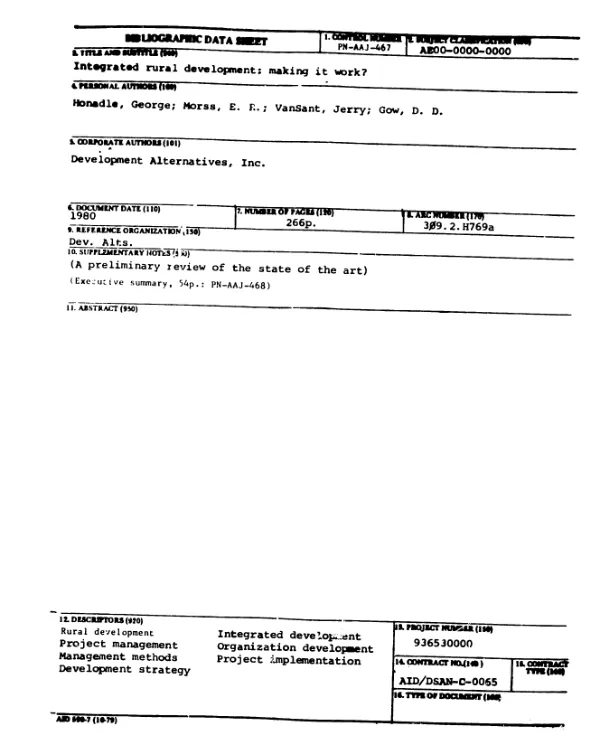
INTEGRATED RURAL DEVELOPMENT : MAKING IT WORK?
As part of an A.I.D.
HONADLE, GEORGE H.; MORSS, ELLIOTT R. · 1970
Sign in to readA free account is required to download.
Abstract
project to assist managers of integrated rural development (IRD) projects, in which success depends as much on effectively mobilizing complex resources as on technical expertise, this report, based on a 2-year experience in 10 developing countries, presents the state-of-the-art in IRD project management. Around the two key factors of organizational design and managerial tactics, the report details a wide range of perennial problems and choices faced by IRD project managers in delivering goods and services, eliciting local response, and effecting self-sustaining improvements. The resulting practical guide, in which the need for choices involving trade-offs is continually noted, stresses the following elements as essential: For the delivery of goods and services, effective organizational design requires choosing an appropriate level of centralization or decentralization and a capable host agency and in establishing a clear and coordinated chain of command. Managers, who should possess management skills prior to the project"s inception, need to base decisions in these areas -- particularly regarding technical assistance strategies -- on sound data and know-how to exercise authority in informal, collegial, and motivative ways. To elicit local response to development initiatives, a sound organizational design should incorporate the use of local organizations to include villagers in the decisionmaking processes, while managers should use flexible strategies in coordination with local leaders. The persistence of unforeseen negative side effects of IRD efforts and lack of a clear concept of welfare itself make measuring self-sustaining welfare highly uncertain. Such welfare seems best attainable in projects which are small-scale and deal with critical constraints; require local resource commitments and build local organizational and management capabilities; share implementation responsibilities between villagers and project staff; and create and use a management information system. A 518-item bibliography in English, French, and Spanish (1955-80) is included.