USAID. MISSION TO ECUADOR
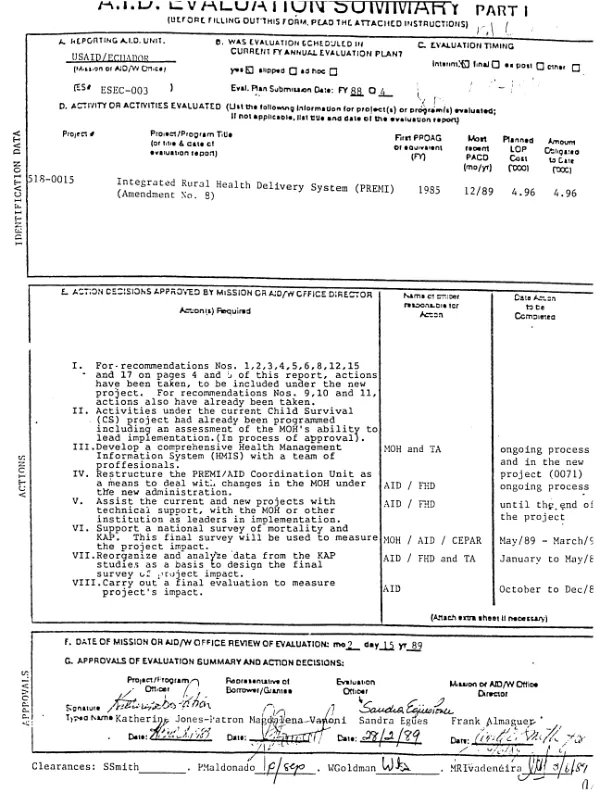
Integrated rural health delivery system (PREMI) (amendment no. 8)
Summarizes attached midterm evaluation (XD-AAZ-157-A) of a project to reduce child morbidity and mortality in Ecuador.
1989
Sign in to readA free account is required to download.
Abstract
The evaluation covers the period 6/85-8/88. The project has had a positive impact despite a number of quantitative shortfalls. Project interventions have contributed to the stabilization of infant mortality rates for those at risk during a period of severe economic difficulties. The expansion of health services and effective use of oral rehydration therapy (ORT) has played a beneficial role in illness prevention and mortality among children under age 5. Additionally, the project has helped to develop national awareness about child survival (CS) and effective ways to diminish risk of infant/child morbidity and mortality, though whether it has led to permanent behavioral changes remains unclear. Some important interim objectives - the vaccination of 80% of all children under age 1 against DPT and polio, of all pregnant women in high risk areas with tetanus toxoid, and of all children aged 1-4 against DPT, polio, and measles - have not been met. Quantitative training goals for Ministry of Health (MOH) personnel were met, but the training"s qualitative impact needs further study. TA was generally uncoordinated and lacked Ecuadorean counterparts, while none of the major health information activities were completed due to a lack of unity and continuity of effort. The division of project administration among the MOH, the National Child and Family Institute, and USAID/E reduced commitment to the project. Weaknesses in the project"s design process included: (1) the absence of a strategy designed specifically for Ecuador; (2) inappropriate resource targeting; (3) inadequate lead time for project development; and (4) lack of appropriate management procedures in the project amendment. Major recommendations are to: (1) give priority to DPT, polio, and measles immunization of children under age 1 with a target of 80% coverage; (2) design an overall strategy for the breastfeeding and nutrition/growth monitoring programs which focuses on child feeding, breastfeeding, and appropriate weaning practices, training of health workers, and maternal education. (3) link national campaigns to expand services and increase coverage rates to the strengthening of permanent CS institutions; (4) give an Ecuadorean institution such as the MOH the lead role in project implementation; (5) use mass media and other educational fora to promote CS; and (6) make a major commitment to develop and improve a national health information system.