USAID. BUR. FOR SCIENCE AND TECHNOLOGY. OFC. OF HEALTH
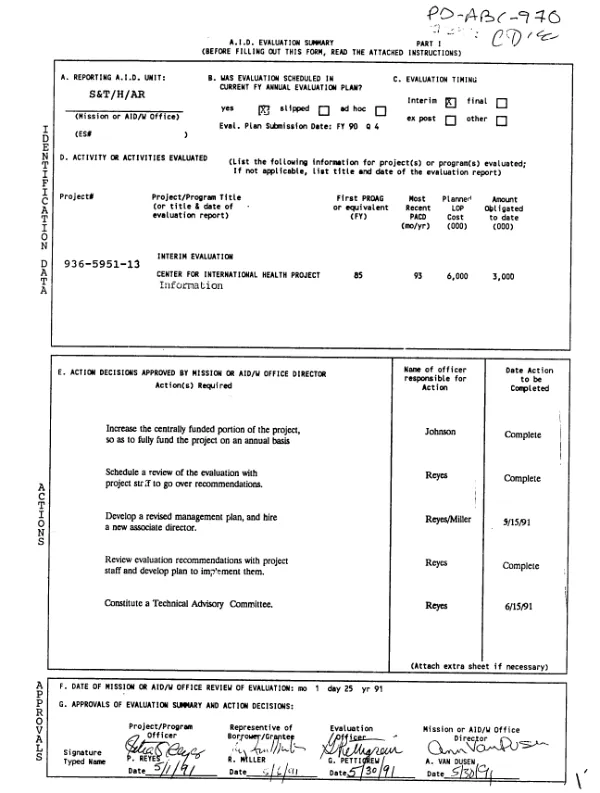
Interim evaluation : Center for International Health Information
Summarizes mid-term evaluation (PD-ABC-558) of a project to establish the Center for International Health Information (CIHI) as a mechanism for supporting the planning, management, and evaluation of A.I.D."s health and child survival program.
1991
Sign in to readA free account is required to download.
Abstract
The evaluation covered the period FY85-1/91. Under management of the International Science and Technology Institute (ISTI), CIHI is fulfilling its charge of maintaining and expanding the two data bases entrusted to its care -- the health projects data base (HPD) and the health statistics data base (HSD). Except for the AIDS and Nutrition Offices, users of the HPD praised the quality and comprehensiveness of its information. Data are gathered from Missions and contractors through questionnaires; compliance is very good, even though the completion of surveys is considered an onerous task. While the HPD and the Bureau for Program and Policy Coordination"s Activity Codes/Special Interest (ACSI) data base are somewhat redundant, most A.I.D./W users have considerably more confidence in the accuracy of the HPD. The HSD, which contains an extensive array of indicators on health, child survival, nutrition, infant feeding, AIDS, demography, etc., is essential to preparing the annual child survival report to Congress (the centerpiece of ISTI"s information dissemination efforts), country/regional profiles, and the project"s information services. Data quality is quite high, given the limitations of secondary sources. Computer equipment is satisfactory, though development of a Local Area Network (LAN) should be explored. ISTI sees itself primarily as a service organization for S&T/Health and has been reluctant to act as a data depository, watchdog, or disseminator for the health field at large. Other accomplishments include: (1) completion of 3 of 8 planned case studies, with 2 more in progress; (2) preparation and dissemination of an extensive number of reports on trends in funding as well as health and child survival indicators; and (3) completion of high-quality reports to Congress on child survival and AIDS. Additionally, the Information Service has been used extensively by A.I.D./W and other organizations. On the negative side, ISTI has not yet developed any policy dialogue tools, awareness of the project"s information services could be greatly increased, and much more time needs to be spent assessing the use of funding and indicator data for planning, managing, and evaluating projects and programs. Overall, ISTI has performed very well in carrying out the contract"s scope of work, and has been extremely responsive to the diverse and increasing demands placed upon it by A.I.D. Unfortunately, this responsive performance was not accompanied by adequate reporting to A.I.D. on the impact of these increasing demands. Beginning in FY90, the contractor faced a reduction in core funding, while still trying to carry out the original scope of work, plus responding to various other demands. A restoration of core funding is recommended. In addition, A.I.D. should remember that buy-ins create considerable more work, and therefore are not an ideal source of additional funding.
Related documents
![Evaluation of the media/materials clearinghouse [M/MC]](https://covers.devme.ai/gen/5026.webp)