USAID DEC
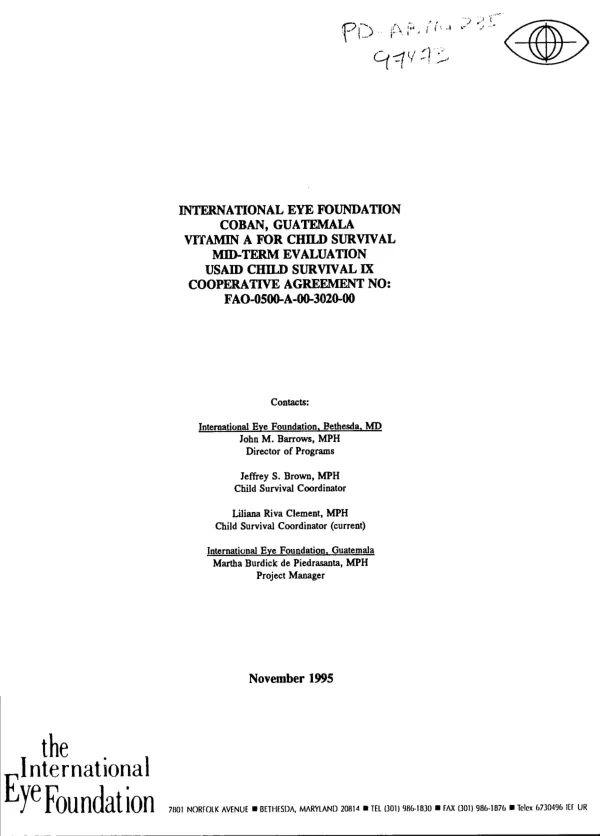
International Eye Foundation, Coban, Guatemala : vitamin A for child survival -- mid-term evaluation : USAID child survival IX, cooperative agreement no. FAO-0500-A-00-3020-00
Sign inINTERNATIONAL EYE FOUNDATION (IEF)
International Eye Foundation, Coban, Guatemala : vitamin A for child survival -- mid-term evaluation : USAID child survival IX, cooperative agreement no. FAO-0500-A-00-3020-00
Evaluates grant to the International Eye Foundation (IEF) for a child survival/vitamin A program in Guatemala.
Brown, Jeffery|Alvarez, Edmundo · 1995
Sign in to readA free account is required to download.
Abstract
Mid-term evaluation covers the period 10/93-7/95. More than 50% of project objectives have been reached in the following components: Expanded Program of Immunization (EPI) (children aged 12-24 months receive a complete scheme except for DPT), nutrition (children over 5 months receive vitamin A-rich foods), vitamin A (children aged 6-71 months receive vitamin A supplements every 6 months and postpartum mothers receive vitamin A within 30 days), acute lower respiratory infections (mothers can identify the warning signs and make an appropriate referral, eye care (eye campaigns held), and income generation activities. Mothers, volunteers, and leaders are aware of and support project activities, find that the activities help them improve both their children's health and their own, and recommend that volunteers be trained as health promoters. Ministry of Health (MOH) workers and local medical staff agree that the project is well-known and respected, and indicate a willingness to train volunteers as health promoters. A network of NGOs has been strengthened due to close communication and cooperation with project activities. Educational activities have employed a variety of media, including cooking demonstrations and radio spots. The following components need to be strengthened or re-examined: EPI (TTV for women of child-bearing age), control of diarrheal disease (use of oral rehydration therapy and solution [ORS and ORT] and antibiotics), nutrition (food during episodes of diarrhea), and gardens (planting of family gardens). There is also a need to reduce the number of educational messages (the result of the excessive number of project interventions), ensure that the messages are not contradictory, and remedy the lack of educational materials usable at the community level. Finally, there is a need to strengthen institutional and financial sustainability -- institutional sustainability through formal agreements between the MOH and local communities and through better and more frequent contacts with the MOH, the Catholic Church and other local churches, and NGOs; and financial sustainability by diversifying income sources for the project and by seeking funding to further establish IEF's role as an expert in community education and research.
Related documents
Documents in this collection
 1995
1995USAID DEC
International Eye Foundation, Coban, Guatemala : vitamin A for child survival -- mid-term evaluation : USAID child survival IX, cooperative agreement no. FAO-0500-A-00-3020-00
Open record![Reducing vitamin A deficiency in western Guatemala : an extension and replication project in three departments -- Quetzaltenango, San Marcos, and Totonicapan : CS-IX [child survival] cooperative agreement no. FAO-0284-A-00-3037-00, final evaluation report](https://covers.devme.ai/gen/55523.webp) 1997
1997USAID DEC
![Reducing vitamin A deficiency in western Guatemala : an extension and replication project in three departments -- Quetzaltenango, San Marcos, and Totonicapan : CS-IX [child survival] cooperative agreement no. FAO-0284-A-00-3037-00, final evaluation report](https://covers.devme.ai/gen/5773.webp)