USAID. BUR. FOR SCIENCE AND TECHNOLOGY. OFC. OF AGRICULTURE
IRRI Malagasy rice research
Summarizes attached evaluation of a project to develop a mechanism for the exchange of information and materials between the International Rice Research Institute (IRRI) and Madagascar"s Department of Agricultural Research (FOFIFA).
1988
Sign in to readA free account is required to download.
Abstract
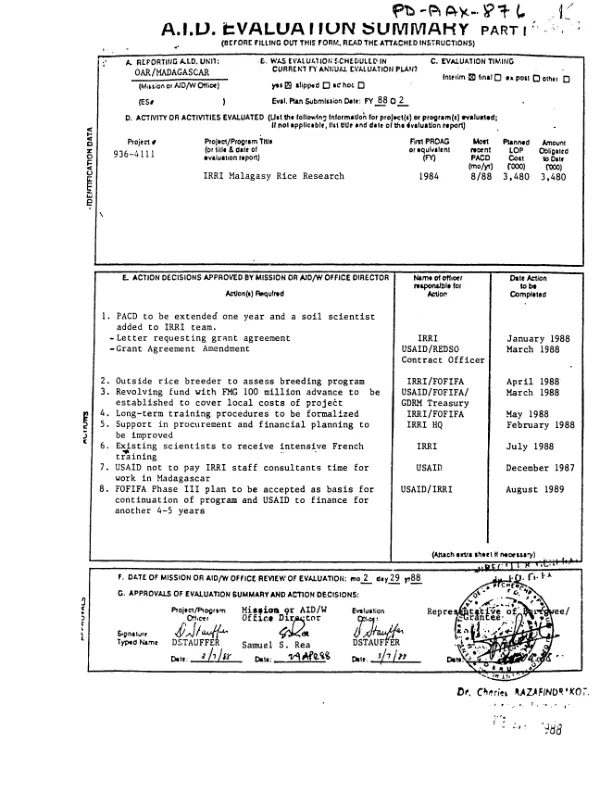
Interim evaluation covers 1984-11/88 and is based on document review and interviews with project personnel and potential beneficiaries. Excellent progress has been made overall, with only long-term training falling short due to a lack of candidates, a matter over which IRRI has little control. Support to FOFIFA has enabled good progress to be made on evaluating both local and imported rice varieties (the latter including over 1,000 entries from 23 countries) for specific climatic characteristics and disease resistance. In 1987, 213 crosses were made to identify varieties with desired traits. Thus, selection, breeding, and agronomic testing are on schedule. Constraints to greater yields, e.g., cold tolerance, phosphorus deficiency, iron toxicity, and disease resistance, have been identified and are being addressed. Quarantine problems, which had earlier prevented testing of imported germplasm, were resolved with the rehabilitation of the existing greenhouses. Requirements for the introduction of F-1 crosses from IRRI have also been revised, considerably reducing the time required for such material to be introduced into the country and tested for release. Also, in response to a recommendation from the first evaluation, rice research is being conducted in cropping systems context. FOFIFA and IRRI researchers are fully aware of local constraints and are addressing them; thus, there is no need to add a farming systems specialist to the research team. Further, short-term training in FSR at IRRI and in-country consultancies are already promoting and institutionalizing the method. It was learned that: (1) U.S. training for Francophone scientists is particularly difficult due to language barriers and the fact that institutional awards (such as promotions) are based on the French degree system; (2) the introduction of breeding material for a major food crop is always difficult due to the fear of disease introduction, a problem compounded in an island society; (3) despite the Green Revolution"s success, results from a breeding program for a complex crop such a rice never materialize as soon as expected; (4) the introduction and/or breeding of new germplasm is only one part of the "revolution"s" potential for success; (5) projects with clearly defined goals are often expected to produce outputs well beyond those originally intended; (6) the timely allocation of local currency from P.L. 480 generations does not guarantee timely disbursements (this has been the single most limiting constraint on the project). A 4-5 year project extension is strongly recommended.
Related documents