USAID DEC
Irrigated corn production in Chile : increasing yields through intensive irrigation management
Sign inUTAH STATE UNIVERSITY
Irrigated corn production in Chile : increasing yields through intensive irrigation management
A three-year program involving research and demonstration on modern concepts of irrigation management for corn was conducted in the Aconcagua Province.
Stutler, R. K.; Kidman, Don C. · 1970
Sign in to readA free account is required to download.
Abstract
Irrigation, land management, fertility, corn variety and plant population were emphasized. Results proved that yield potential of corn is well above the current level of production. By adopting the practices in this bulletin, corn producers can increase yields at least 50% with the resources they currently have available. While all of the research was conducted in the Aconcagua Province, the technology can be transferred to other provinces in the corn producing area with slight modification or adaptation. Based on the results of the project, the following recommendations are made for increased corn production in Chile. Proper timing and amount of irrigation is essential for increased production, since corn is very susceptible to moisture stresses. Even short periods of moisture stress, particularly during the critical stages of tasseling and silking, will sharply reduce yields. Plowing should be done prior to irrigation at a 25-30 cm. depth to adequately incorporate residue from previous crops. A preplant irrigation should then be applied. Seed-bed preparation can be done after the soil is dry enough to prevent undue compaction by equipment. The tandem disc should be followed by a spike-tooth harrow to break up clods and leave a fine surface mulch. A recommendation of 200 kg. of N per hectare would be adequate for most soils in Aconcagua. In the event that the field has a history of heavy use of nitrogen fertilizer, smaller applications may be sufficient. Several good varieties of corn are available in Chile, including short and full season hybrids. If water is limited, a short season hybrid may be used with greater assurance that enough water will be available to bring the crop to maturity. If irrigation water is not limited then the long season hybrid will produce higher yields.
Related documents
Documents in this collection
 1970
1970USAID DEC
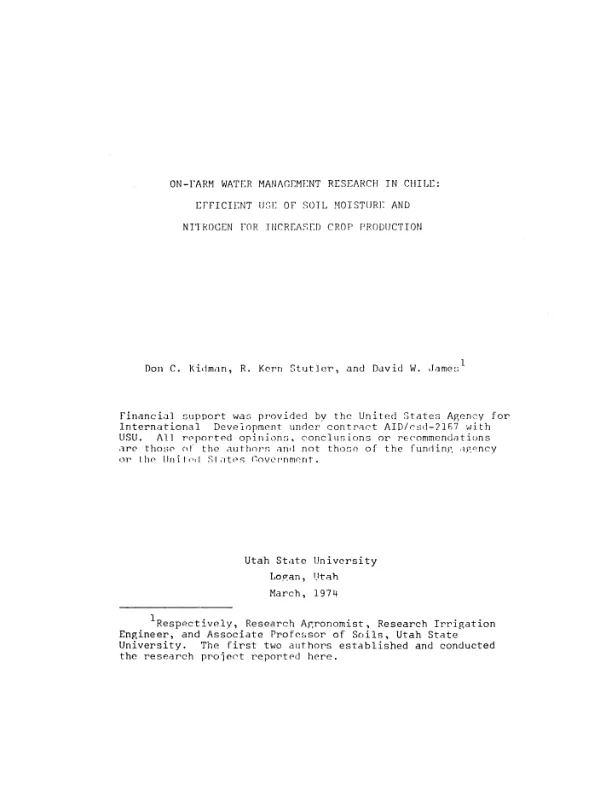
On - farm water management research in Chile : efficient use of soil moisture and nitrogen for increased crop production
Open record 1970
1970USAID DEC