USAID
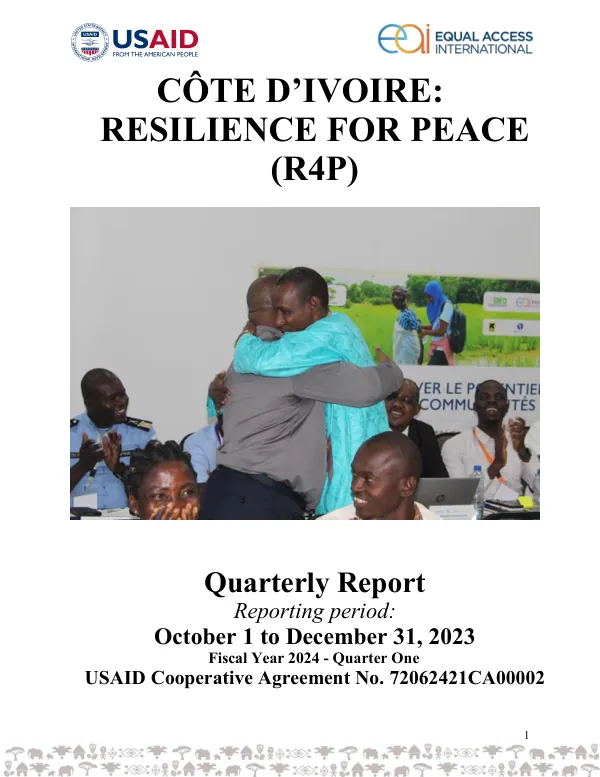
IVORY COAST: RESILIENCE FOR PEACE (R4P) Quarterly Report
The Resilience for Peace (R4P) project in Côte d'Ivoire continued to support community development and counter violent extremism (CVE) efforts in the northern border area during the first quarter of the 2024 fiscal year.
2024 · 48 pages
Sign in to readA free account is required to download.
Abstract
The project's governance team supported Community Action Groups (GACs), which held 17 public activities with 1,234 participants, encouraging community members to collaborate. R4P also hosted community ecosystem meetings in four different communities, resulting in the creation of WhatsApp groups to facilitate sharing of activities. The project's Natural Resource Management (NRM) team worked alongside four collective assistance groups (CAGs) bringing together 466 participants in four communities to assist local farmers. The NRM team organized dialogues in three communities to discuss the creation of local transhumance corridors, resulting in two of the communities endorsing corridors to help reduce cattle theft. Meanwhile, 156 participants in Flabougou and Madina took part in trainings to adopt alternatives to gold mining. The Economic Livelihoods team supported fencing work on the market garden perimeters for four communities, with 557 participants (including 440 women) cooperating to ensure future protection from crop damage. A new group of literacy training cycles began in November at 12 centers, with 227 learners participating in first and 132 learners in second cycle courses. The apprenticeship program continued and expanded, supporting 62 young people (including 10 women) in learning 18 different trades. The gender-based violence (GBV) team launched the component with an event to familiarize the team with GBV. Additional activities included a capacity building and financial training for 14 participants, field research for the situation analysis report, and producing content on social media to spread awareness on the 16 days of activism against GBV. The R4P media team produced 13 simultaneous broadcasts this quarter across the 13 partner radio stations and continued holding community validation groups which drew in 97 participants. The media team also held socio-cultural exchanges in four localities to strengthen community ties with 1,429 participants in total. This quarter, the team began casting and producing the pilot episode of a radio soap opera and held six castings for interested individuals. CVE-related incidents documented by R4P during the reporting period included 19 incidents, with the majority being crimes or community conflicts. The most notable incidents were the arrival of 50 refugees in Tougbo on November 9 and 100 refugees in Tougbo on November 28. The FDS Operations were also reported in several incidents, including the arrest of one person in Goueya on November 3 and the operation in Tengrela on December 7. The R4P project continued to support community development and CVE efforts in the northern border area, with a focus on natural resource management, economic livelihoods, and gender-based violence. The project's activities aimed to promote community collaboration, reduce cattle theft, and increase awareness on GBV. The CVE-related incidents documented during the reporting period highlighted the ongoing security challenges in the region. The project's governance team continued to support Community Action Groups (GACs), which held 17 public activities with 1,234 participants. The NRM team worked alongside four collective assistance groups (CAGs) bringing together 466 participants in four communities to assist local farmers. The Economic Livelihoods team supported fencing work on the market garden perimeters for four communities, with 557 participants (including 440 women) cooperating to ensure future protection from crop damage. The GBV team launched the component with an event to familiarize the team with GBV. The R4P media team produced 13 simultaneous broadcasts this quarter across the 13 partner radio stations and continued holding community validation groups which drew in 97 participants. The media team also held socio-cultural exchanges in four localities to strengthen community ties with 1,429 participants in total. The R4P project's activities aimed to promote community collaboration, reduce cattle theft, and increase awareness on GBV. The project's focus on CVE efforts and community development continued to support the overall security context in the northern border area.