USAID DEC
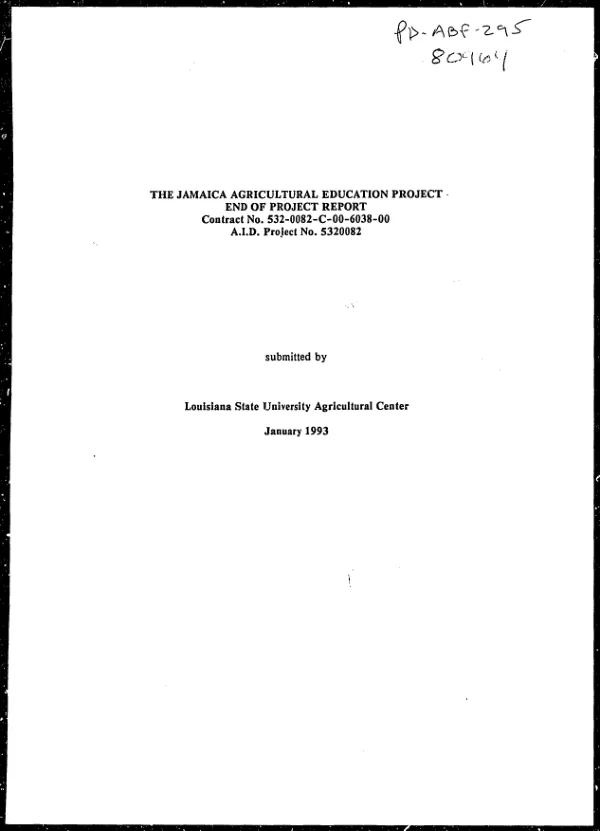
Jamaica agricultural education project : end of project report, contract no. 532-0082-C-00-6038-00, AID project no. 5320082
Sign inLOUISIANA STATE UNIVERSITY AGRICULTURAL CENTER
Jamaica agricultural education project : end of project report, contract no. 532-0082-C-00-6038-00, AID project no. 5320082
Final contractor report on a project (1984-92) to upgrade Jamaica"s College of Agriculture (COA) and its feeder secondary school, the Knockalva Agricultural School (KAS).
Heagler, Arthur M. · 1993
Sign in to readA free account is required to download.
Abstract
The project has succeeded in some areas and failed in others, but successes probably outnumber failures. Participant training was a notable success: 29 persons earned a total of 33 academic degrees (20 B.S., 11 M.S., and 2 Ph.D.s), substantially upgrading the level of instruction at both institutions. Strong research and extension programs have not yet been developed at COA. While an applied research program is emerging, a clear research agenda has not been articulated (and is badly needed). Similarly, COA has made several attempts to develop an extension/outreach program, but lack of continuity has been a problem here. A professional extension coordinator was hired to address this problem, but the integration of faculty into extension has not occurred, and there has been little progress. These programs should be given priority. While COA"s curriculum was made more responsive to the dynamic needs of the agricultural sector, the effort to establish a COA Curriculum Development Center was a failure. Curriculum development at KAS was hindered by the participant training program, since replacements for faculty sent were almost impossible to find. The problem is less pressing now that most trainees have returned home, although the Ministry of Education salary scale will make it difficult to retain B.S.-trained faculty, especially those qualified in agribusiness. Construction at COA resulted in an academic and administrative physical plant capable of supporting a student population of 400, but housing for faculty and students is only marginally adequate. At KAS, a modification of the construction plan deleted the multipurpose structure and faculty housing, both of which were sorely needed. Dormitory capacity was expanded, and the school can now support a student population of 190. However, support facilities, particularly the library, are severely taxed. Procurement was fraught with problems. In particular, the project"s failure to upgrade COA"s library collection was a major shortcoming; library deficiencies are now the chief impediment to accreditation of the COA. Combining KAS procurement requests with those of COA was a serious mistake, especially for the welfare of KAS. Good progress was made in the area of COA administration. Accomplishments included passage of the College of Agriculture Act, creation of the College of Agriculture-Jamaica Foundation; (within which an endowment for COA is to be established soon); and upgraded administrative and accounting procedures. However, budgetary problems have reduced the annual subvention to both institutions, while recurring costs have increased (due partly to project initiatives). Internal income generation was stressed in the project paper; although the government provided farmland to both institutions to meet this requirement, thus far only COA has succeeded.
Related documents