USAID DEC
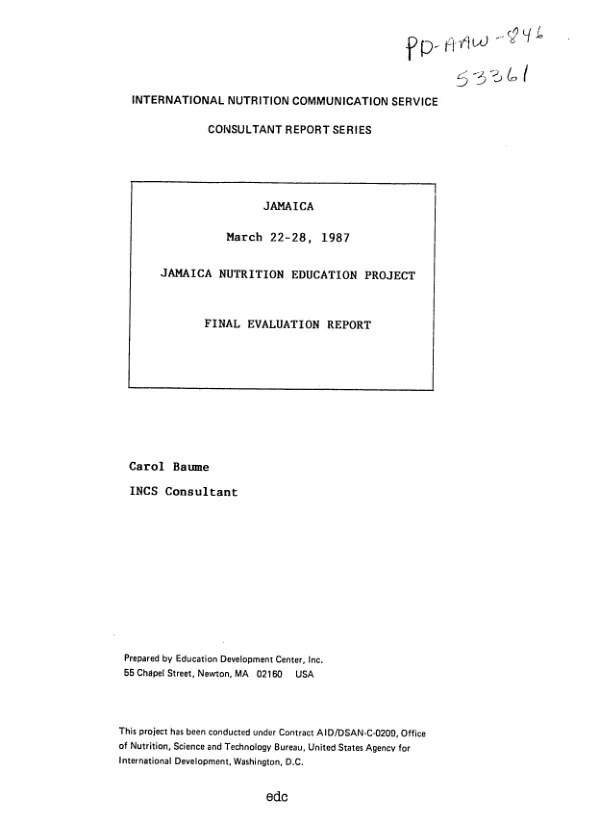
Jamaica, March 22-28, 1987, Jamaica nutrition education project : final evaluation report
Sign inEDUCATION DEVELOPMENT CENTER, INC. (EDC)
Jamaica, March 22-28, 1987, Jamaica nutrition education project : final evaluation report
Evaluates project to promote nutrition in Jamaican primary school children through a reading program that uses a nutrition-oriented primer.
Baume, Carol · 1987
Sign in to readA free account is required to download.
Abstract
Evaluation, prepared by the contractor (the International Nutrition Communication Service, or INCS), is based on students' pre- and post-test scores and a survey of participating teachers, and covers the 1986-7 school years. The project introduced innovative reading materials (which had been developed using a "fusion methodology" - a combination of techniques from formal curriculum design, nonformal education, and social marketing) to 4th and 5th graders in 15 pilot schools in Clarendon parish. The primer, called "The Nutrition Magician," was designed to convey nutrition messages relevant to the everyday life of the child through a number of formats (e.g., comics, stories, essays) in order to engage readers of varying abilities. Test results show that pupils in the pilot schools made modest but statistically significant gains in nutrition knowledge, while the control group made no gain, and that the pilot group also made better progress in reading than the control students. More importantly, pilot students' interest in learning was reported to be very high, and in many instances was translated into behavior change - there was a trend toward eating better breakfasts and less junk food. Teacher evaluations of the project were favorable; they recommended that the lessons be expanded to cover more grades, and that new topics (dental care, the digestive process, food preparation, etc.) be introduced. Most teachers thought that the project should expand to other schools. While the success of the materials can be attributed to the use of different presentation formats and pictures based on local settings, another factor in project success was the "bottom up" approach to the development of the primer, so that teachers collaborated from the outset, retained a special interest in the project, and remained an important source of feedback throughout the process. Teachers were also given the latitude to use the materials as they saw fit, and were allowed to proceed at their own pace. This sparked their creativity and demonstrated the project's respect for them as professionals.