MEDICAL SERVICE CORP. INTERNATIONAL
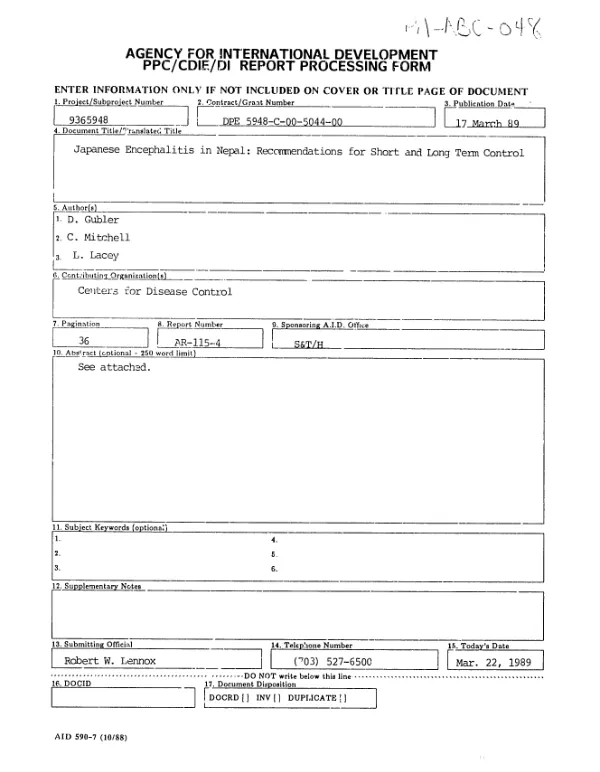
Japanese encephalitis in Nepal : recommendations for short and long term control
A joint U.S.
Gubler, Duane J.; Mitchell, Carl J. +1 more · 1989
Sign in to readA free account is required to download.
Abstract
Centers for Disease Control/Vector Biology Control Project team reviewed the Japanese encephalitis (JE) problem in Nepal and available in-country resources that could be used to address future JE outbreaks. Since 1978, when the first epidemic occurred, there has been a JE epidemic every other year, with increasing numbers of cases and deaths. In 1988, 1,371 cases of JE and 397 deaths were reported. For each case of human encephalitis there are an estimated 20 to 1,000 JE virus infections, suggesting that in 1988 there were between 27,000 and 1.4 million JE virus infections in Nepal. Infection with JE virus may result in a nonspecific viral syndrome and lost workdays. JE vaccines are commercially available, but the expense and logistic difficulties associated with wide scale administration, coupled with difficulties in identifying target populations and questions about JE virus strain differences, preclude their use in Nepal at this time. Recommendations for short-term interventions that could be implemented with existing resources include water management in irrigated rice field mosquito breeding sites, use of bed nets and insecticidal coils, zooprophylaxis, and alteration of animal husbandry practices. More long-term interventions, such as the use of biological control agents, will require comprehensive ecological data on the vector mosquitoes and their interaction with the biological control agents in Nepal. (Author abstract)