FAMILY HEALTH INTERNATIONAL
Job Aid for Providing Services to Clients Returning for NET-EN Reinjection
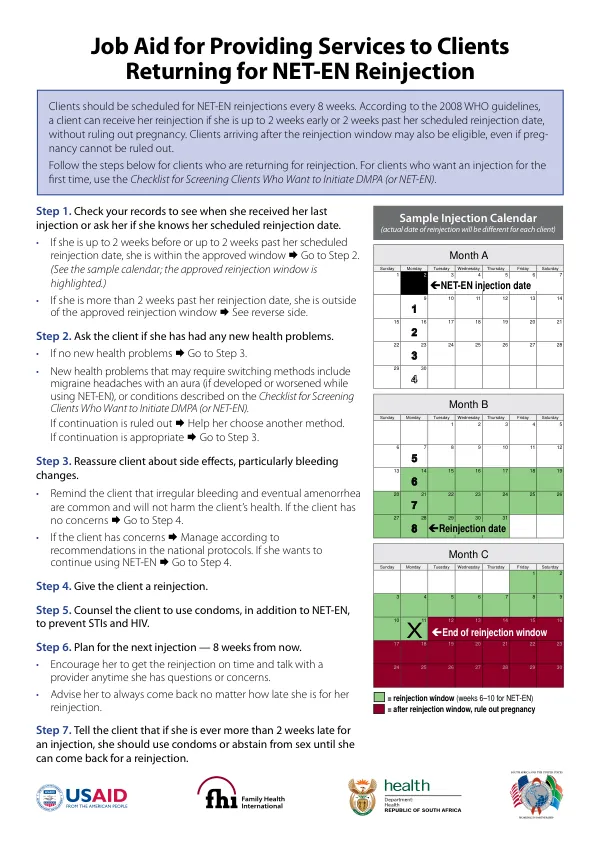
The World Health Organization's guidelines for NET-EN reinjections specify that clients should be scheduled for reinjections every 8 weeks.
2009 · 2 pages
Sign in to readA free account is required to download.
Abstract
According to the 2008 WHO guidelines, a client can receive her reinjection if she is up to 2 weeks early or 2 weeks past her scheduled reinjection date, without ruling out pregnancy. Clients arriving after the reinjection window may also be eligible, even if pregnancy cannot be ruled out. The job aid for providing services to clients returning for NET-EN reinjection outlines a step-by-step process to determine eligibility for reinjection. The first step involves checking the client's records to determine when she received her last injection or asking her if she knows her scheduled reinjection date. If the client is within the approved window, she is eligible for reinjection. If she is more than 2 weeks past her reinjection date, the provider must follow the instructions on the reverse side of the job aid. The job aid also emphasizes the importance of assessing the client's health and side effects, particularly bleeding changes. The provider should reassure the client that irregular bleeding and eventual amenorrhea are common and will not harm her health. If the client has concerns, the provider should manage them according to national protocols. The client should be given a reinjection and counseled to use condoms, in addition to NET-EN, to prevent STIs and HIV. The job aid also provides guidance on how to handle clients who arrive more than 2 weeks after their scheduled reinjection date. In such cases, the provider should attempt to rule out pregnancy using one of three options: the Modified Pregnancy Checklist, a pregnancy test, or an understanding that the injection may not abort or harm an existing pregnancy. If pregnancy cannot be ruled out, the provider should discuss other method options that may be more suitable for the client. Common side effects of NET-EN include irregular bleeding, no monthly bleeding, abdominal bloating and discomfort, ordinary headaches, weight gain, mood changes, changes in sex drive, and dizziness. It may take somewhat longer to become pregnant after stopping NET-EN, and NET-EN does not make women permanently infertile. The provider should assess the client's intention regarding possible pregnancy and refer her to antenatal care or another facility for pregnancy testing or pelvic/abdominal exam if necessary. The job aid is based on the World Health Organization's guidelines and the National Contraception Service Delivery Guidelines of the Republic of South Africa. The guidelines emphasize the importance of providing high-quality contraceptive services, including NET-EN reinjections, to clients.