CREATIVE ASSOCIATES INTERNATIONAL INC.
Jordan ERSP Quarterly Report (Jan to Mar 2013)
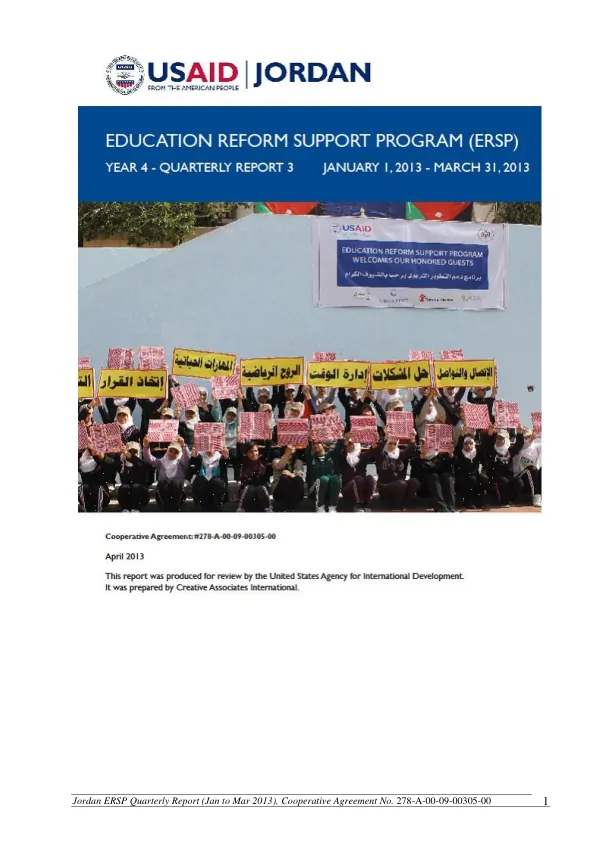
The Education Reform Support Program (ERSP) in Jordan began its third quarter of Year Four in January 2013, with the period of performance extending to July 31, 2014.
2013 · 49 pages
Sign in to readA free account is required to download.
Abstract
The program faced uncertainty in the Ministry of Education due to the formation of a new national government following parliamentary elections in late January. The Ministry's annual budget was feared to be less than requested and had not yet been announced at the end of the reporting period. Despite these challenges, ERSP continued to implement its activities, with a focus on the Early Childhood Education component. The Comprehensive Training Program (CTP) for kindergarten teachers was prepared for implementation, and training for grade 1-3 teachers was conducted. The Regional Working Groups gained momentum by engaging the private sector, local community, and media in their efforts to expand access to quality kindergarten. Visits to kindergartens throughout the Kingdom revealed that most teachers were effectively organizing the classroom, engaging parents in volunteer activities, and using the self-assessment tool that is part of the Quality Assurance system. The Youth, Technology and Careers component continued to implement the School to Career program in 84 schools and Life Skills through Sports with 33 schools. The Counseling Directorate began its own roll out of STC activities in 30 schools, according to the agreed work plan, indicating a promising sign for sustainability. The Professional Development component continued to shine, with the Ministry's consistent success in implementation of in-service training. The ERSP and the MoE's leadership programs were well implemented, and the MoE Reform team made slow but steady progress on teacher, principal, and supervisor standards. The Data Use component was busy with roll-out, reaching 205 schools in 15 Field Directorates this quarter, and providing 490 on-site support visits to follow up on data use after the initial training. The Planning Directorate faced budget constraints, and thus committed to train the first half of the agreed roll-out target in the summer and the second half in the fall when more funds were secured. The Ministry followed up on the action steps identified in the Data Policy Dialogue, which was conducted last quarter. ERSP also realigned its budget and received a two-month contract extension to enable the project to complete activities in alignment with the academic calendar. The period of performance now ends on July 31, 2014. The program's activities were rescheduled in affected areas to ensure the safety of staff and trainees due to civil unrest in isolated regions in the South of the Kingdom. The ERSP's implementation of the Comprehensive Training Program for kindergarten teachers and the training for grade 1-3 teachers were key highlights of the quarter. The program's focus on strengthening the capacity of Ministry ECE staff, improving and sustaining early childhood facilities, and enhancing the skills and behaviors of ECE personnel were also notable achievements. The program's efforts to increase parental involvement and peer support in ECE and improve the quality of the overall kindergarten experience for children were also significant. The ERSP's implementation of the School to Career program in 84 schools and Life Skills through Sports with 33 schools was another key highlight of the quarter. The program's focus on enhancing the MIS curriculum, institutionalizing the School-to-Career program, and improving life skills education were also notable achievements. The program's efforts to develop and implement an induction program for teachers, in-service professional development, and change leadership training for principals and supervisors were also significant. The ERSP's implementation of the Data Use component, which reached 205 schools in 15 Field Directorates this quarter, was a notable achievement. The program's focus on improving capacity at the school level, central and field directorate levels, and strengthening monitoring and evaluation of the JEI were also significant. The program's efforts to improve the capacity of the Ministry of Education to deliver professional development programs and enhance institutional capacity to deliver PD programs were also notable achievements.