USAID. MISSION TO JORDAN
Jordan housing policy program
Summarizes interim evaluation (PD-ABK-193) of a Housing Guaranty (HG) program to improve the institutional and policy environment for the production of formal housing for low-income families in Jordan.
1994
Sign in to readA free account is required to download.
Abstract
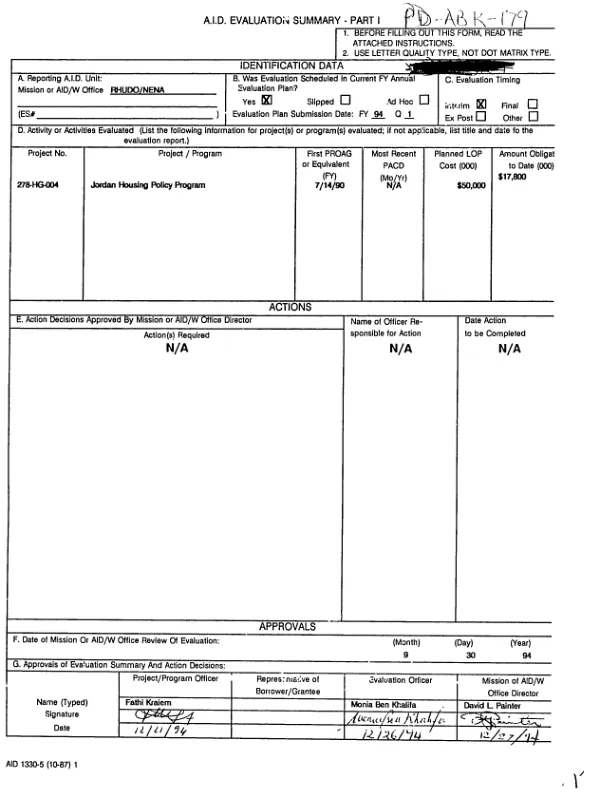
The evaluation covered the period 7/90-12/94. As of 3/93, the Government of Jordan (GOJ) has met all the conditions for the first disbursement of HG funds, and it has proceeded in implementing individual recommendations from the National Housing Strategy and the HG policy menu. Implementation has been slower than anticipated, however, due to extraordinary external events and to a major institutional change. External events have included the Gulf War, the subsequent absorption of the massive numbers of returnees to Jordan, and a downturn in diplomatic relations between the United States and Jordan as a result of the war. The major institutional change has been the merger of the former Urban Development Department and the Housing Corporation into the Housing and Urban Development Corporation (HUDC), which is now USAID"s principal counterpart in the HG program. Only limited coordination has thus far taken place due to the lack of strong leadership in the housing sector. HUDC has been given the mantle of leadership, but has not as yet been ready to assume this role. However, it has prepared a new Corporate Business Plan which includes the privatization of its land development function and the strengthening of both its policy making and upgrading functions; both these efforts will be supported by a new World Bank loan. The return of the expatriate workers following the War has led to a housing boom which has exacerbated housing disparities between high- and low-income households. Even middle-income families are finding it difficult to obtain decent, affordable shelter, and there is growing danger that overcrowding will become a major problem in Jordan"s housing sector again. Conservative planning attitudes and bureaucratic resistance to reductions in the minimum plot size have slowed implementation of the recommendations from the Land Reconnaissance Survey. The Survey has, however, succeeded increasing awareness among the technical staff of various municipalities that people cannot afford the large plot sizes prescribed by the zoning regulations. Private developers have shown little interest in building housing for low-income households. A proposal is now before the Cabinet, however, which will extend all of HUDC"s privileges and incentives (e.g., smaller plot sizes, relief from the property transfer tax, access to advantageous financial terms, etc.) to those private developers willing to enter the low-income market. Lessons learned include the following. (1) While the basic orientation and recommendations of the National Housing Strategy officially guide the sector, there remains a great deal to be done in terms of its implementation. The same is true of the HG policy menu. Some proposed policy actions have not been implemented and need to be reevaluated and updated to meet current conditions. Policy formulation should be a dynamic phenomenon. (2) HUDC"s Board of Directors should assume a greater role in policy formulation and implementation. HUDC also needs to develop stronger research links with other data gatherers, such as local universities; outside support would generate greater support for the policy making process while helping HUDC to reduce its own staffing requirements. (3) A methodology and protocol for working with local authorities in the developing neighborhood upgrading projects are essential.
Related documents