USAID. MISSION TO JORDAN
Jordan - potash plant
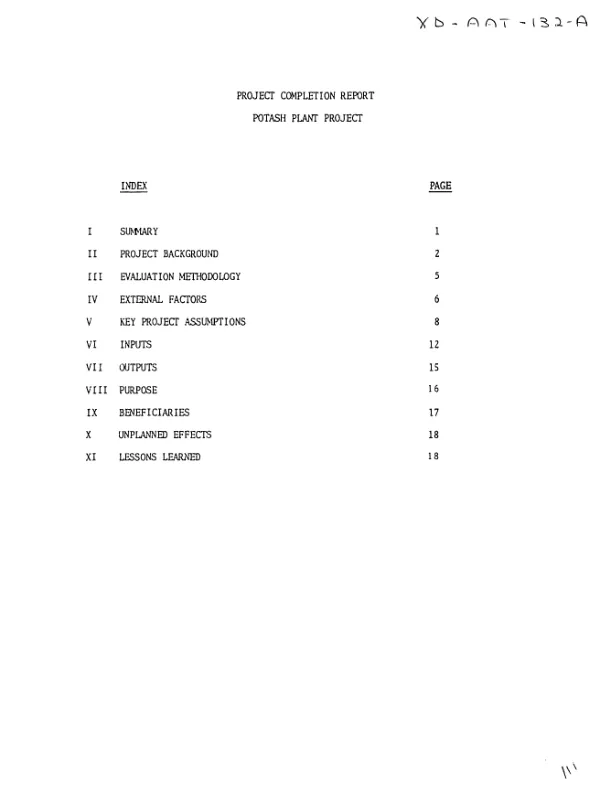
PES of Mission project completion report (8/78-1/86) of project to help the Government of Jordan (GOJ) install a plant to produce potash for export and thus increase foreign exchange earnings.
Stalla, Stanley; Ensour, Ali · 1986
Sign in to readA free account is required to download.
Abstract
Project funds lent to the Arab Potash Company (APC) financed the foreign exchange costs of plant design and construction supervision services and such materials as fiberglass reinforced pipe, carnalite harvesters and spare parts, and refinery equipment, machinery, and spare parts. Despite the complex technical nature of the project, the number of donors involved, and the remoteness of the project site and corresponding infrastructure challenges, actual costs remained close to original estimates and construction of the plant was completed within schedule, a notable achievement. The project was unable to generate income, however, due to a number of unanticipated factors: an initial delay in potash production; failure of the solar evaporation pans to produce potash at the designed level; technical problems within the refinery; much lower than projected world potash prices; and possible difficulty in obtaining Jordanian managers to replace foreign consultants. Nevertheless, the APC expects to break even in 1986, as potash production levels increase, and to operate profitably by 1987. A lesson learned is that a project of such size and complexity could never have been implemented on schedule without concerted coordination on the part of APC and donors. This coordination effort included following international contracting procedures, whenever possible, and conducting annual donor meetings; future multidonor projects should be designed and implemented with the same degree of coordination. It is recommended that USAID/J continue to assist the APC in correcting problems and developing ideas for plant expansion and diversificaton. USAID/J is actively discussing privatization of the APC and is considering partial financing of a feasibility study of plant expansion as a follow-on; if the follow-on is approved, USAID/J will allocate up to $1.5 million from its Technical Services and Feasibility Studies V project. (Near East Evaluation, modified)
Related documents