RTI INTERNATIONAL
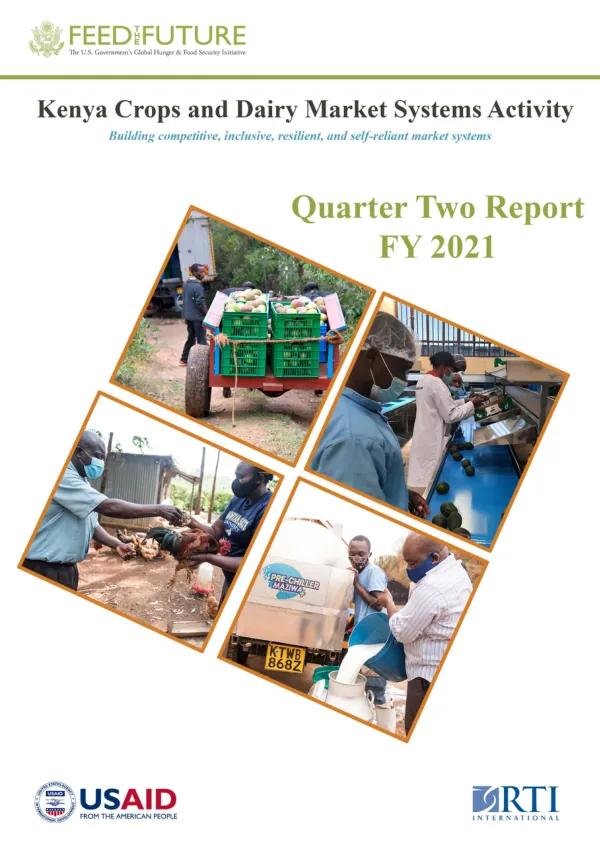
Kenya Crops and Dairy Market Systems Activity Progress Report, Quarter 2 FY 2021
Kenya Crops and Dairy Market Systems Activity Progress Report, Quarter 2 FY 2021, highlights the performance of the initiative in various areas.
2021 · 107 pages
Sign in to readA free account is required to download.
Abstract
Local partnerships have been established, with a focus on diverse agricultural production and improved productivity. The initiative aims to create competitive, inclusive, and resilient market systems, with a supportive policy environment for market development. Implementation of the initiative has led to enhanced agricultural production and improved productivity, with a focus on targeted commodities such as horticulture and dairy. The initiative has also promoted the adoption of private-sector extension systems and expanded agricultural input supply systems. Access to diverse, safe, and nutritious foods has been improved, with a focus on promoting local production and consumption. Market systems organization and capacity have been enhanced, with a focus on strengthening the capacity and profitability of lead firms, agribusinesses, and micro, small, and medium-sized enterprises (MSMEs). Access to financial services has been improved, with a focus on promoting domestic, regional, and regional trade. The initiative has also promoted the development of a supportive policy environment for market systems development. Integration of women and youth into agricultural market systems has been a key focus of the initiative. Support has been provided for market facilitation and linkages for youth and women, with a focus on increasing access to finance and resources. A communication strategy has been established to promote youth empowerment in agribusiness. The initiative has also contributed to improved natural resource management, with a focus on reducing the environmental impact of agricultural production. Collaboration and learning have been promoted through the use of the adopt-adapt-expand-respond framework. Evidence of systemic change has been collected, with a focus on behavior change communication. Challenges have been faced, including the COVID-19 pandemic, which has had a significant impact on agricultural production and market systems. Other challenges have also been identified, including limited access to finance and resources for smallholder farmers. Lessons have been learned from the initiative, including the importance of collaboration and learning in promoting market systems change. The initiative has also highlighted the need for a supportive policy environment and access to finance and resources for smallholder farmers. The initiative has established links with other stakeholders, including other USAID and development partners. Financial information is also provided, including details of the initiative's budget and expenditure.