INTERNATIONAL STATISTICAL INSTITUTE
KENYA FERTILITY SURVEY, 1978 : A SUMMARY OF FINDINGS
At its current annual population growth rate of 4%, Kenya"s population of about 15.3 million people will double in 18 years.
1970
Sign in to readA free account is required to download.
Abstract
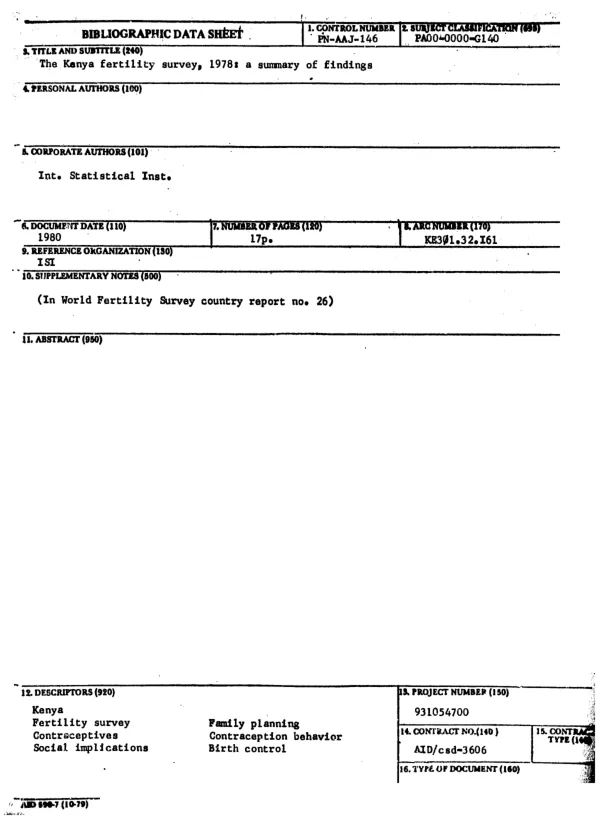
This International Statistical Institute (ISI) survey report assesses factors contributing to Kenya"s growth rate: the strength of marriage, high fertility rates, preference for larger families, limited contraceptive usage, and the slight effect of noncontraceptive factors upon fertility. From 8/77 to 5/78, ISI interviewed 8,100 single and married women from 8,891 households. ISI"s most important discovery was Kenya"s extremely high fertility rate, an average of eight children per woman. Of these, an average of 6.3 survive -- with only 2.5 children required for a balanced population level. Additional data suggest an increase in population fertility over the past 15 years. Responses to questions about preferred family size indicate that Kenya has a very pronatalist culture. Most women wanted large families and only a few, including those who already had six children, wished to have no more. Although 88% of the women (in all categories) had heard of at least one contraceptive method, only 29% had tried one and only 11% had used a modern one. Of the 4,217 married women surveyed on current contraceptive usage, only 6% used modern methods. Breast-feeding, which reduces fertility by delaying menstruation, seems to be widely practiced. However, there is evidence of its decline among younger, educated, and urban women. Sexual abstinence due to recent childbirth or spouse separation seems to have little effect upon fertility. Only 16% of those ever married (defining marriage, as per the 1969 Kenya census, as a union sanctified by religious or civil law including stable sexual relationships between partners living together) had their first marriage dissolved; 52% of these remarried. While data indicate the widespread practice of polygamy is declining, further study is needed in this area. The female age at first marriage is rising -- 18.1 was the median age at marriage for those now 20-24 years old, as opposed to 17.1 for those now 30-34 years old. While the postponement of marriage lowers the fertility rate somewhat, more effective policies are needed to reduce the rate still further.