USAID DEC
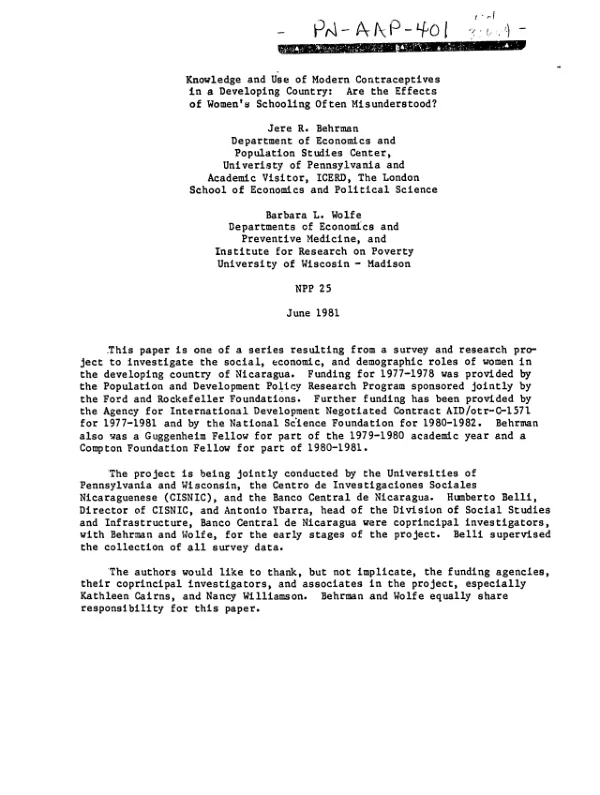
Knowledge and use of modern contraceptives in a developing country : are the effects of schooling often misunderstood?
Sign inUNIVERSITY OF PENNSYLVANIA. DEPT. OF ECONOMICS AND POPULATION STUDIES CENTER
Knowledge and use of modern contraceptives in a developing country : are the effects of schooling often misunderstood?
As part of a series investigating the social, economic, and demographic roles of women in Nicaragua, this paper examines the use of modern contraceptives, using data from a random national sample of 3,215 currently or previously accompanied women of childbearing age.
Behrman, Jere R.; Wolfe, Barbara L. · 1981
Sign in to readA free account is required to download.
Abstract
The authors found that 88% of the sample have knowledge of modern contraceptives (e.g., pills, I.U.D."s, diaphragms, condoms), and that of the 2,839 women who knew of contraceptives, 53% have used them. Knowledge and use of contraception was positively correlated with schooling level, degree of urbanization, and human capital variables (i.e., a woman"s predicted earnings) and to a lesser extent with household income and family background variables; the effects of schooling were strongest among rural women and were important even after controlling for labor market variables. The authors conclude that while female schooling is related to labor market variables and to efficiency in information use, it also is representing some other important factors in contraceptive use and fertility; policy implications are briefly discussed. Tables showing logit estimates and a 43-item (1950-1981) bibliography are appended.
Connected topics