USAID DEC
Knowledge utilization and the process of policy formation : toward a framework for Africa
Sign inACADEMY FOR EDUCATIONAL DEVELOPMENT, INC. (AED)
Knowledge utilization and the process of policy formation : toward a framework for Africa
This paper focuses on the process of policy formation.
Porter, Robert W.; Hicks, Irvin · 1995
Sign in to readA free account is required to download.
Abstract
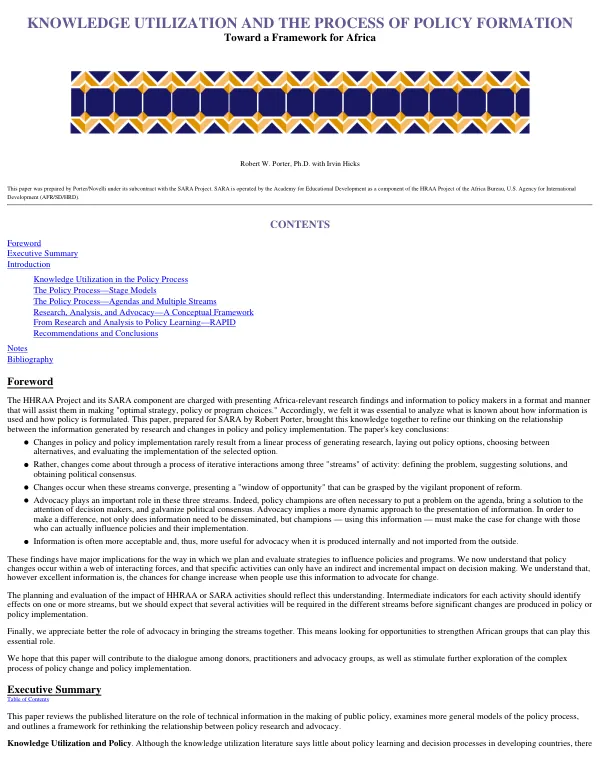
It reviews published literature on the role of technical information in the making of public policy, examines more general models of the policy process in an effort to fashion a conceptual vocabulary that facilitates a clearer understanding about the ways in which research and analysis contribute to policy making, and outlines a framework that it is hoped will prove useful in planning and evaluating project activities aimed at improving policy decisionmaking. For the most part, the paper focuses on big policy decisions -- government decisions that set broad direction for specific programs. Almost every big decision combines technical expertise and the play of power (or politics). Some things are settled by facts, analysis, and persuasion. Others are settled by vote, by bargaining, or by the decision of someone delegated to make authoritative choices. Politics, in this sense, refers to the (more or less) collective choices of people who disagree. Political decisions are authoritative in the sense that the coercive power of government stands behind them. For this reason, the interplay of technical knowledge and politics in the policy process is a recurring theme in the paper. A major conclusion is that if researchers and analysts want to have a direct impact on policy, they may need to abandon the posture of the neutral technician and embrace the more actively committed one of advocate. At the very least, policy projects should recognize that much of what they are about is persuasion and argumentation and not simply the kind of self-confined, academic research that has inspired the utilization question. (Author abstract, modified)