PACIFIC CONSULTANTS
LABOR MIGRATION IN SOUTHERN AFRICA AND POSSIBLE SUPPLIER STATE ALTERNATIVES
Reports on labor migration in southern Africa, with particular emphasis on migration from the majority-ruled states (Botswana, Lesotho, Malawi, Mozambique, Namibia, Swaziland, and Zimbabwe) to the mining sector of the Republic of South Africa.
WALKER, GARY A.; LOVELACE, WILLIAM · 1970
Sign in to readA free account is required to download.
Abstract
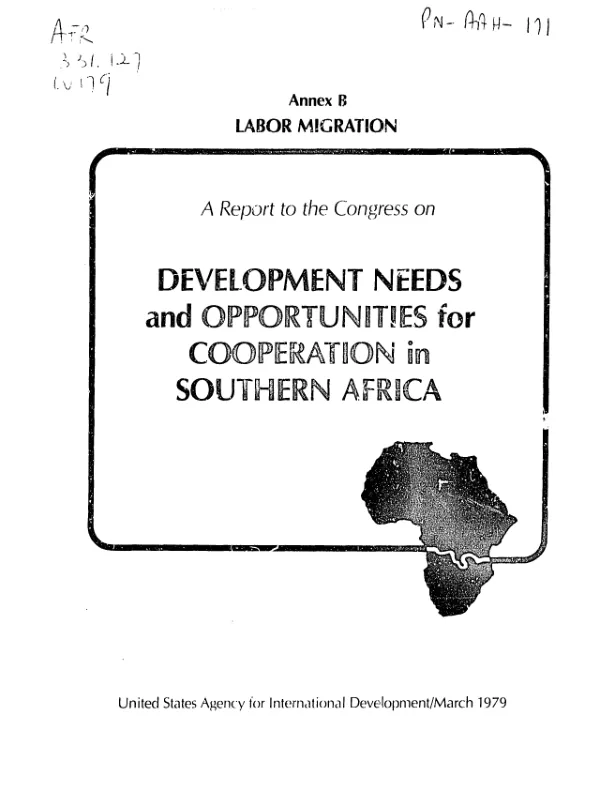
Report constitutes an annex to an AID report to Congress on development needs and opportunities in the region. The report is divided into four main sections: (1) a country-specific account of the effects of labor migration on the supplier states; (2) conditions under which migrants work and live; (3) the impact of migration on the Republic of South Africa; and (4) an analysis of possible alternatives to migration. Migration in southern Africa is a longstanding and vast problem; two hundred thousand migrants are employed in the Republic of South Africa"s mining sector alone. The effects of this migration are uniformly adverse. Development in the supplier states is hindered by the absence of a large percentage of the labor force (up to 60% in Lesotho) for most of the year causing heavy dependence on a powerful, racist neighbor. The workers themselves undergo a dehumanizing, prison-like experience characterized by lack of privacy, forced homosexuality, and confrontation. The Republic of South Africa"s black majority is negatively affected in terms of working conditions, wages, and employment opportunities. Regional migration patterns are changing, however. Supplier states have declared their intention to withdraw their labor and the Republic of South Africa plans to reduce the number of migrant laborers. Immediate withdrawal, however, would create serious economic effects for the supplier states. A better approach seems to be a phased withdrawal tied to schemes to promote sector job creation and increased productivity in the supplier states, coupled with increased donor assistance, including creation of a UN fund for supplier state support and supplier state initiative to strengthen their position vis-a-vis the Republic of South Africa. Detailed recommendations, including recommendations for U.S. action, are provided. Included are statistical tables illustrating the report"s findings, a bibliography on labor migration in southern Africa, and a list of U.S. and foreign contacts made by the report"s authors.
Related documents