USAID DEC
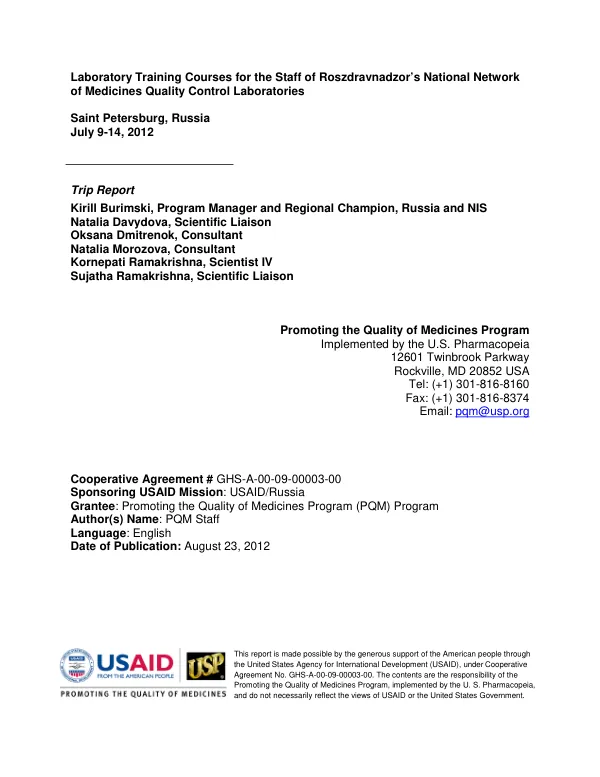
Laboratory Training Courses for the Staff of Roszdravnadzor’s National Network of Medicines Quality Control Laboratories
Sign inUNITED STATES PHARMACOPEIA
Laboratory Training Courses for the Staff of Roszdravnadzor’s National Network of Medicines Quality Control Laboratories
Laboratory Training Courses for the Staff of Roszdravnadzor’s National Network of Medicines Quality Control Laboratories were conducted in Saint Petersburg, Russia from July 9-14, 2012.
2012 · 17 pages
Sign in to readA free account is required to download.
Abstract
The training courses were developed by the Promoting the Quality of Medicines (PQM) Program, implemented by the United States Pharmacopeia (USP), in collaboration with Roszdravnadzor, the Federal Service on Surveillance in Healthcare and Social Development of the Russian Federation. Four training courses were held on validation of analytical methods, medicine sample preparation, atomic absorption spectroscopy, and identification of residual organic solvents. The training materials were developed by USP and translated into Russian by experts in relevant fields. The presentations were jointly refined by USP and RZN to suit the needs of the RZN staff. Thirty-four individuals representing ten regional/federal district labs participated in the training courses, which were held at Roszdravnadzor’s Saint Petersburg Medicines Quality Control Laboratory. By the end of the training, participants were competent in validation and verification of analytical methods, sample preparation, atomic absorption spectroscopy, and identification of residual organic solvents by gas chromatography. The training courses were supported by USAID/Russia through the Promoting the Quality of Medicines (PQM) Program. To minimize costs, RZN covered the expenses of its participants, including travel and accommodations, and provided the venue for the training free of charge. The training courses were designed to meet the needs of the RZN staff, with specific objectives and expected outcomes for each course. The trainers and facilitators included Dr. Kornepati Ramakrishna and Dr. Sujatha Ramakrishna, who provided presentations and hands-on training on the various topics. The training courses were part of a larger effort by USP to promote the quality of medicines in Russia. USP has been working in Russia for nearly two decades, through several mechanisms funded by USAID. In 2009, USP and Roszdravnadzor signed a Memorandum of Understanding (MOU) to explore joint and mutually beneficial education and training programs. The training courses were well-received by the participants, with responses from their evaluations showing great interest and enthusiasm for attending other courses. Dr. Telnova, Acting Director of RZN, expressed appreciation for the training and conveyed the agency’s wish to collaborate on additional trainings in the future. The Promoting the Quality of Medicines (PQM) program is USAID’s response to the growing challenge posed by the proliferation of counterfeit and substandard medicines. By providing technical leadership to developing countries, PQM helps build local capacity in medicine quality assurance systems, increase the supply of quality medicines to priority USAID health programs, and ensure the quality and safety of medicines globally. The PQM program is funded by the U.S. Agency for International Development (USAID) and is implemented by the United States Pharmacopeia (USP). The program has been working in Russia for several years, providing training and technical assistance to Roszdravnadzor and other stakeholders in the Russian healthcare system. The PQM program has a number of goals, including improving the quality of medicines in developing countries, reducing the risk of counterfeit and substandard medicines, and increasing access to quality medicines for vulnerable populations. The program achieves these goals through a range of activities, including training and technical assistance, laboratory testing, and quality control. The PQM program has made significant progress in improving the quality of medicines in Russia and other developing countries. The program has provided training and technical assistance to thousands of laboratory professionals and healthcare workers, and has helped to establish robust quality control systems in many countries. The PQM program is an important part of USAID’s efforts to improve global health and reduce the risk of counterfeit and substandard medicines. The program is a key partner for Roszdravnadzor and other stakeholders in the Russian healthcare system, and is helping to build a stronger, more resilient healthcare system in Russia and other developing countries.