DEVELOPMENT ASSOCIATES, INC.
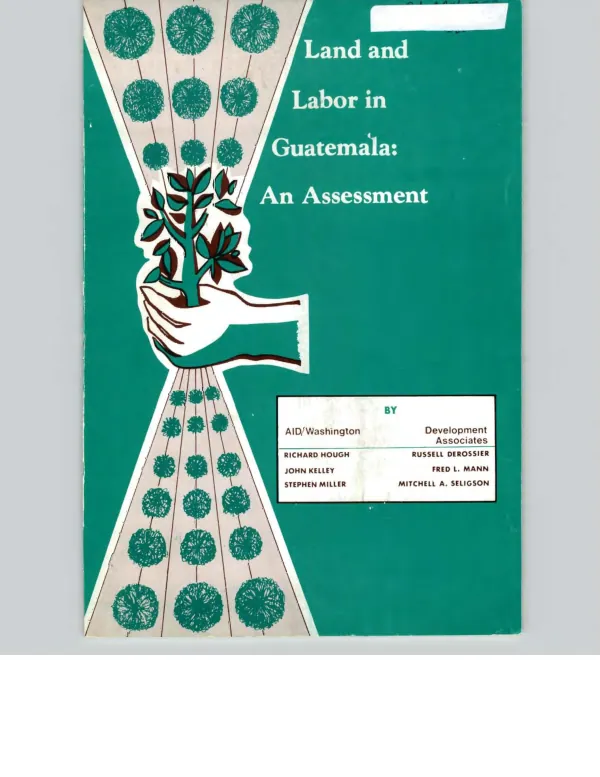
Land and labor in Guatemala : an assessment
Guatemala, more than any other Central American country, suffers from striking inequalities in land distribution.
Hough, Richard L.; Kelley, John C. · 1970
Sign in to readA free account is required to download.
Abstract
This study provides a comprehensive historical and analytical assessment of agrarian reform programs and conditions in the country, with suggestions for further actions by the Government of Guatemala. The report first examines the relationship between land tenancy patterns and landlessness and documents various estimates, made on the basis of soils assessment data, of land potentially available for distribution under current legislation. It is concluded that Guatemala has at best only enough land to accommodate 64% of its landless, and in the worst case only 31%. Patterns of permanent migration, with differences relating to Indian and Ladino populations, are considered. Part 2 of the report explains the historical origins of these patterns and disequilibria and traces government responses over the last century to agrarian reform and land colonization efforts. Emphasis is placed on the post-1955 period, during which the pace of land distribution has slowed and government policies have mainly benefited large landowners and increasingly focused on costly efforts to colonize virgin lands rather than on relatively inexpensive efforts to distribute idle lands in the private sector. An AID-supported program to colonize the Franja Transversal is assessed. Part 3 examines options which the Government of Guatemala, while conforming to its policy of excluding expropriation of privately-owned land in productive use, might consider in future agrarian reform efforts. These include developing an active commercial land market, refining its colonization strategy, and adopting the "La Perla" experiment of converting privately-owned agricultural estates into joint worker-employer enterprises by allowing permanent agricultural workers to purchase shares in the enterprise. A further possibility is the redesign of present agrarian reform legislation to facilitate the distribution of idle lands. Included are a number of annexes containing data developed for the study. A 114-item bibliography (1958-82) cites works in Spanish and English.