USAID. MISSION TO RWANDA
Land tenure in Rwanda
In Rwanda, the most densely populated country in Africa, 95% of the people are dependant on the land, and land tenure is a vital issue.
Reintsma, Mary · 1981
Sign in to readA free account is required to download.
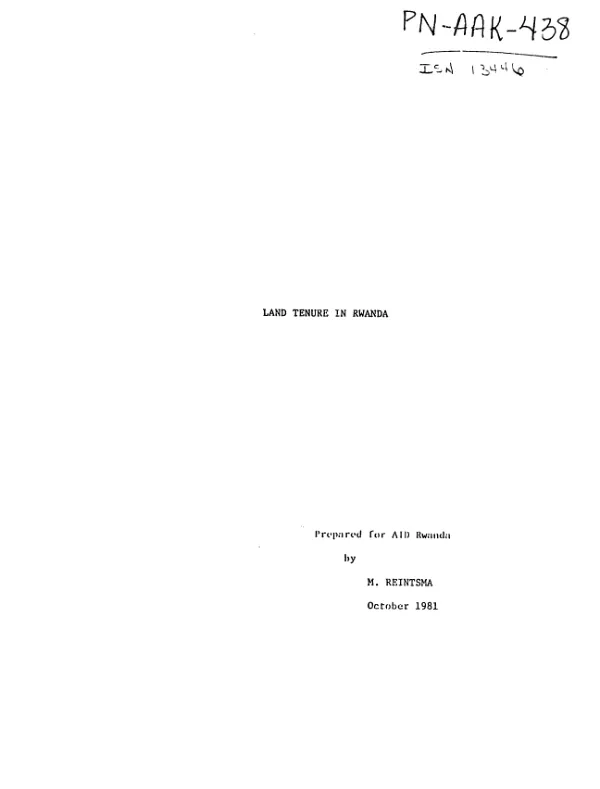
Abstract
This report traces major developments in the sources of customary and written law which have shaped the de jure land tenure system and describes some aspects of the current de facto land tenure system. The development of customary law is closely related to Rwanda"s tribal history, especially the relationship between the farming Bahutu who vested land ownership in the lineage chief and the pastoral Batutsi who centralized ownership in an all-powerful leader (mwami). By 1900, continued tenure over the land depended on paying tribute to a hierarchical network extending from Bahutu farmers, to lineage or hill chiefs, to provincial Batutsi chiefs, and finally to the mwami. Under German (1898-1917) and Belgian (1917-62) administration, lineage groups began to disintegrate and tribute became an oppressive reponsibility of the individual. Through written law, especially after 1948, the Belgians attempted several reforms. With independence, these laws were incorporated into the constitution. The resulting system of traditional ownership under the dictates of customary law, non-traditional ownership governed by written law, and State ownership has made land disputes common. The situation has been worsened by the fact that the application of written law and the content of customary law differs by region and that many written laws are only provisional and do not address the real problems. The de facto land tenure situation is characterized by small, fragmented holdings due to a shortage of agricultural land and has resulted in spontaneous farmer migration to undeveloped or urban areas and government-sponsored migration to less populous areas. The author concludes that reform of land tenure in Rwanda involves few choices given the nearly exhausted land supply, a rapidly growing population, and limited nonfarm employment. It is recommended that agrarian reform based on a codified system of land tenure laws which limits subdivision of holdings, provides for consolidation of scattered plots, and sets a maximum size for holdings be implemented.
![Some considerations for the new [Rwanda] parliament](https://covers.devme.ai/gen/30889.webp)
![[Agricultural] land tenure study, phase II](https://covers.devme.ai/gen/37324.webp)