USAID DEC
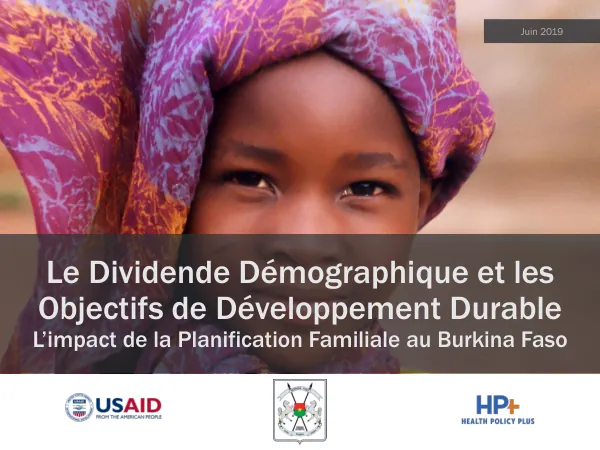
Le Dividende Démographique et les Objectifs de Développement Durable L’impact de la Planification Familiale au Burkina Faso
Sign inUNITED NATIONS
Le Dividende Démographique et les Objectifs de Développement Durable L’impact de la Planification Familiale au Burkina Faso
The demographic dividend is a change in the age structure of a population, characterized by a larger population of working age.
2018 · 44 pages
Sign in to readA free account is required to download.
Abstract
This change is promoted by the demographic transition, which involves a decline in mortality and fertility rates. The demographic dividend encourages changes in population behavior, which in turn can lead to economic benefits. However, to realize the dividend, socio-economic policies must be in place to encourage these changes. The demographic transition has been observed in various countries, including Thailand, Tunisia, and Burkina Faso. The number of children per woman has decreased significantly in these countries, as shown in the table comparing the number of children per woman in these countries from 1960 to 2010. The table also shows the evolution of the population pyramid in Thailand and Burkina Faso from 1970 to 2018, highlighting the shift towards a larger population of working age. The demographic dividend has been realized in Thailand, where the number of children per woman has decreased significantly, leading to a larger population of working age. This has contributed to an increase in the country's GDP per capita, as shown in the graph comparing the GDP per capita of Thailand, Chad, and Burkina Faso from 1960 to 2010. The GDP per capita of Thailand has increased significantly, while that of Chad and Burkina Faso has remained relatively low. The factors that have contributed to the realization of the demographic dividend in Thailand include continued access to family planning, emphasis on education, high savings rates, financial system security, international trade openness, and a flexible labor market. These factors have created a favorable demographic dynamic, which has led to economic benefits. The demographic dividend is closely linked to the Sustainable Development Goals (SDGs), which aim to improve health, education, and economic outcomes. Family planning is a key component of the SDGs, as it helps to reduce the number of children per woman, leading to a more favorable demographic dynamic. This, in turn, can lead to reductions in health risks during pregnancy, decreases in mortality and invalidity rates, and improvements in economic, environmental, and social outcomes.
Related documents