USAID DEC
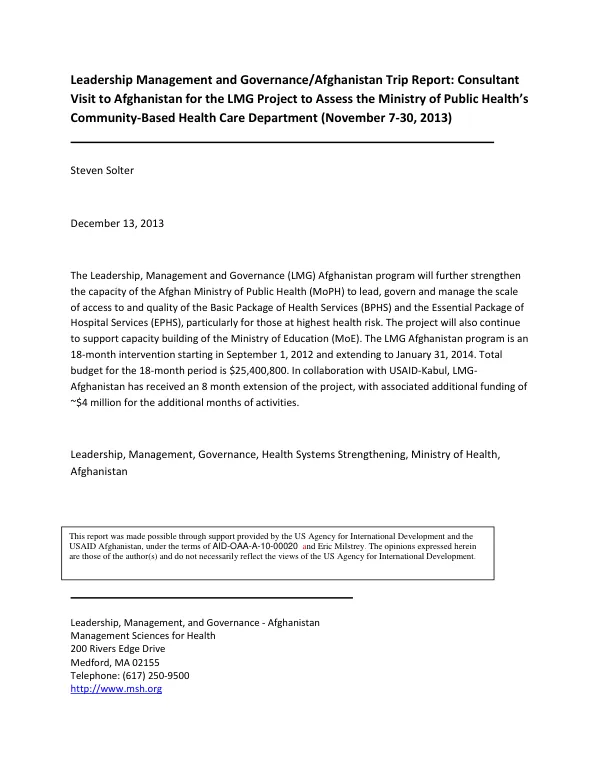
Leadership, Management, and Governance - Afghanistan Trip Report: Consultant Visit to Afghanistan for the Leadership, Management, and Governance Project to Assess the Ministry of Public Health’s Community-Based Health Care Department
Sign inMANAGEMENT SCIENCES FOR HEALTH
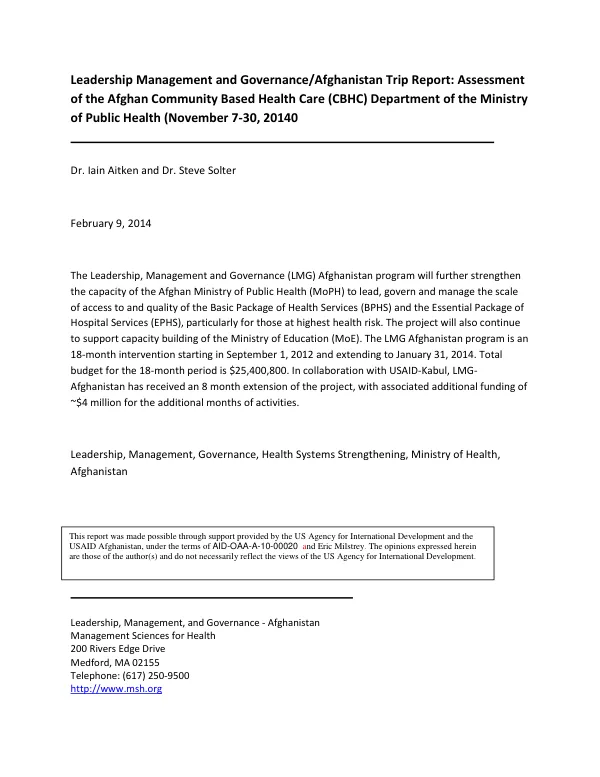
Leadership, Management, and Governance - Afghanistan Trip Report: Consultant Visit to Afghanistan for the Leadership, Management, and Governance Project to Assess the Ministry of Public Health’s Community-Based Health Care Department
The Leadership, Management and Governance (LMG) Afghanistan program aims to strengthen the capacity of the Afghan Ministry of Public Health (MoPH) to lead, govern, and manage the Basic Package of Health Services (BPHS) and the Essential Package of Hospital Services (EPHS).
2013 · 5 pages
Sign in to readA free account is required to download.
Abstract
The project, which began on September 1, 2012, and is set to end on January 31, 2014, has a total budget of $25,400,800. An 8-month extension of the project was granted, with additional funding of approximately $4 million. The LMG Afghanistan program is an 18-month intervention that focuses on capacity building of the Ministry of Education (MoE) in addition to the MoPH. The program's goal is to support the MoPH in leading, governing, and managing the scale of access to and quality of the BPHS and EPHS, particularly for those at highest health risk. The program's objectives include assessing the capability of the Community-Based Health Care (CBHC) Department of the MoPH, examining the appropriateness of selected CBHC interventions, assessing the role of CBHC in improving community access to quality health services, and identifying existing gaps and challenges that the CBHC may face without external support. A consultant visit to Afghanistan was conducted from November 7-30, 2013, to assess the CBHC Department of the MoPH. The visit was led by Steven Solter and Dr. Iain Aitken, who evaluated the capability of the CBHC Department in terms of effective leadership, sound management, and transparent governance practices. The assessment found that the CBHC Department has done an excellent job developing the CBHC program, supporting the training and supervision of more than 28,000 volunteer CHWs, expanding access to CBHC for the urban poor and for nomads, and working with provincial health offices, technical units of the MoPH, and NGOs to strengthen CBHC in Afghanistan. However, the assessment also identified several gaps and challenges that the CBHC Department may face without external support. These include a lack of focus on achieving specific public health results, such as increased immunization coverage, and a lack of effective integration of CBHC with other key technical programs. The assessment also found that the CBHC Department has not become directly involved with revising NGO contracts to ensure that key CBHC elements are rapidly scaled-up throughout the country. The consultant visit made several recommendations to strengthen the capacity of the CBHC Department of the MoPH. These include fully implementing the CBHC component of the LMG Project's workplan in 2014 to strengthen the capacity of the CBHC Department, keeping the entire consultant staff and making them regular MoPH staff funded through an on-budget process, and making the CBHC Department a Directorate given its importance in the Afghan health delivery system. The recommendations also include focusing on Phase II of the CBHC program, achieving tangible improvement in results and health impact, and closer integration with the technical units of the MoPH.