USAID DEC
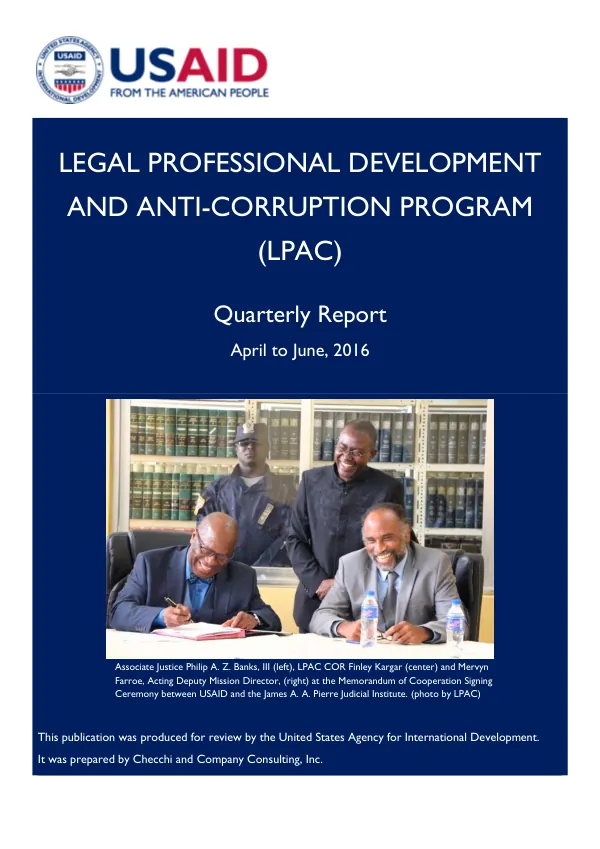
Legal Professional Development and Anti-Corruption Program in Liberia (LPAC) Quarterly Report – April to June, 2016
Sign inCHECCHI AND COMPANY, CONSULTING, INC.
Legal Professional Development and Anti-Corruption Program in Liberia (LPAC) Quarterly Report – April to June, 2016
The Legal Professional Development and Anti-Corruption Program (LPAC) in Liberia is a five-year activity implemented by Checchi and Company Consulting, Inc.
2016 · 34 pages
Sign in to readA free account is required to download.
Abstract
under contract with the United States Agency for International Development (USAID). The program aims to promote a more effective and accountable formal justice sector through improved capacity of five legal institutions: the James A. A. Pierre Judicial Institute (JI), the Louis Arthur Grimes School of Law (Law School), the Liberia Legal Information Institute (LiberLII), the Liberian National Bar Association (LNBA), and the Liberia Anti-Corruption Commission (LACC). LPAC consists of two components. Component A focuses on strengthening legal professional development institutions in Liberia, with a particular emphasis on building the capacity of the JI. This component supports human and institutional capacity development (HICD) at four legal educational, information, and professional institutions, with the ultimate aim of making those institutions financially and administratively sustainable. During the quarter, LPAC made significant progress on three fundamental activities aimed at building capacity within the JI. These activities included addressing major administrative deficiencies identified in the HICD Assessment, establishing an M&E system, and advancing the initiatives of the Judiciary Committee for the Advancement of Court Management. LPAC advisors met with JI technical and administrative groups to assess operational policies and staff capacity to perform basic back office functions. Technical assistance focused on developing administrative, personnel, and training policies. The Judiciary Committee for the Advancement of Court Management (JCACM) made significant progress towards improving staff development and court administration training by developing criteria and standards for court management tailored to Liberia. LPAC led the JCACM in exploring international best practices in court administration and developing recommendations on ways to improve human resource management and the organization of court operations. LPAC also completed drafts of three court management curricula: Fundamentals of Human Resource Management, Ethics for Court Employees, and Court Executive Development Program. Each of these curricula will become part of JI's training for the first generation of court administrators. To support the Ethics curriculum, LPAC drafted a model code of conduct for court employees, which will be presented to the Supreme Court for consideration. The newly embedded M&E team worked within the JI to establish an integrated M&E system. The M&E framework uses a four-step model for acquiring information: needs assessment, baseline study, ongoing program evaluation, and post-program impact evaluation. The first execution of the M&E system focused on the PMTP, with a baseline study of the PMTP students and an in-depth computer competency skills assessment. LPAC also continued to support the PMTP and assisted the JI in conducting the Quarterly Judges Training program. The program aims to guide the JI in developing an annual calendar and catalogue of programs. The Judiciary Committee for the Advancement of Court Management is planning a retreat in Q4 to be trained on the curriculum and to finalize HR recommendations before presenting a report to the Supreme Court and the Court Administration Office. The program has made significant progress in building the capacity of the JI and other legal institutions in Liberia. The establishment of an M&E system will provide a pool of information to guide project teams and other relevant stakeholders in measuring performance and tracking progress in achieving desired goals. The program's focus on institution capacity building will help ensure sustainability of the targeted institutions.
Related documents