USAID DEC
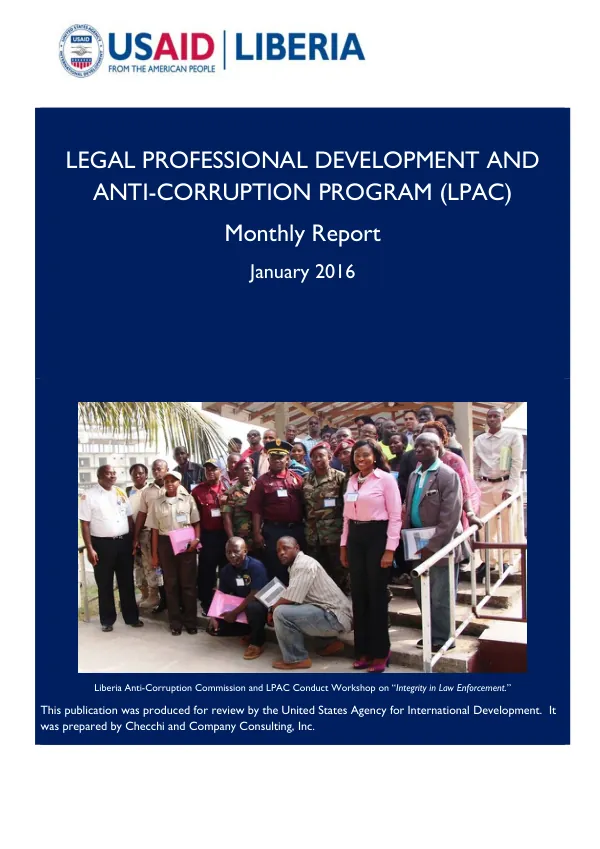
Legal Professional Development and Anti-Corruption Program (LPAC) Monthly Report January 2016
Sign inCHECCHI AND COMPANY, CONSULTING, INC.
Legal Professional Development and Anti-Corruption Program (LPAC) Monthly Report January 2016
The Legal Professional Development and Anti-Corruption (LPAC) program is a five-year intervention designed to address two fundamental challenges to Liberia's development as a state following the rule of law.
2016 · 18 pages
Sign in to readA free account is required to download.
Abstract
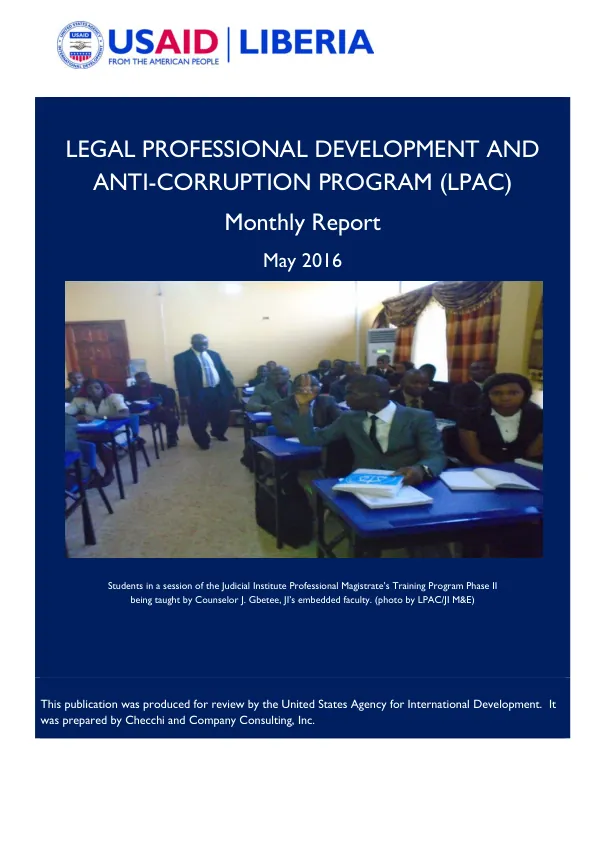
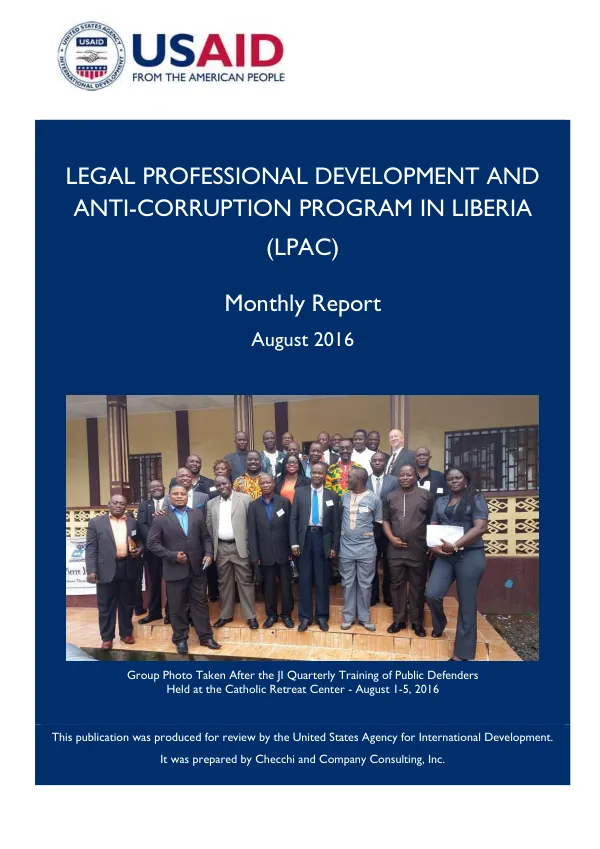
The program aims to increase the capacity of Liberia's legal institutions to produce a high-quality and increased number of judges, magistrates, prosecutors, public defenders, lawyers, and other law-trained actors to maintain an effective legal system, while reducing corruption that undermines that system. LPAC consists of two components structured to address these challenges. The first component comprises capacity building to the four key Liberian justice sector institutions: the Judicial Institute, the Louis Arthur Grimes Law School (Law School), the Liberian Legal Information Institute (LiberLII), and the Liberian National Bar Association (LNBA). These institutions focus on educating, regulating, and informing legal professionals. The second component supports the Liberian Anti-Corruption Commission (LACC) and associated Government of Liberia entities in their efforts to investigate, prosecute, and convict perpetrators of corruption-related crimes, and to educate the public regarding the fight against corruption in Liberia. During January 2016, LPAC achieved several accomplishments. The program contracted a Legal Information Consultant to work with a local IT Advisor to assess and evaluate the technology needs at all five partner agencies. The consultants will assess IT equipment and software facilities to determine ICT needs at each partner institution, and prepare a list comprising technical specifications of the needed equipment, along with recommendations for the management of technological/legal information systems. LPAC and USAID continued to review the language of the Memorandum of Cooperation and refined the planned responsibilities and commitments that will guide activity implementation as described in the Performance Solution Action Plan. The draft MOCs will be shared with each partner agency for their consideration, followed by negotiation dialogues with each agency to reach common ground on the specific responsibilities and commitments that will guide activity implementation. In Component A, LPAC worked with the James A.A. Pierre Judicial Institute to develop a court management curriculum. The Judiciary Committee for the Advancement of Court Management (JCACM) established last quarter began meeting regularly in January, led by LPAC. The JCACM aims to produce a cadre of court management executives trained to international management standards. This month's meetings focused on Human Resource Management, exploring international best practices, identifying gaps in the Liberian court system, and developing policy and procedure recommendations for further consideration by the Court Administration and Supreme Court. LPAC also worked with seconded-magistrate trainers to revise course materials for the Professional Magistrates Training Program (PMTP). LPAC met regularly with trainers to revise the syllabus, refine learning objectives in line with adult education best practices, and update training materials for each module to address recent changes in the law. Several new topics were added to the PMTP, including Introduction to the Legal System of Liberia, Gender Justice, Human Rights and Access to Justice, Court Administration, Juvenile Justice, and Evidence. LPAC assisted the faculty in developing these new modules. Additionally, LPAC worked with the JI to revise the proposed Board By-laws drafted in December. The new By-laws draft now rests with the JI Board Chair and the Chief Justice for their review. LPAC also held a meeting with JI Director to discuss the process of implementing the JI M&E system, monitoring progress towards goals, supporting the development of curricular, and evaluating performance against specific indicators.