USAID DEC
Legal Professional Development and Anti-Corruption Program (LPAC) Monthly Report – March 2016
Sign inCHECCHI AND COMPANY, CONSULTING, INC.
Legal Professional Development and Anti-Corruption Program (LPAC) Monthly Report – March 2016
The Legal Professional Development and Anti-Corruption (LPAC) program is a five-year intervention designed to address two fundamental challenges to Liberia's development as a state following the rule of law.
2016 · 24 pages
Sign in to readA free account is required to download.
Abstract
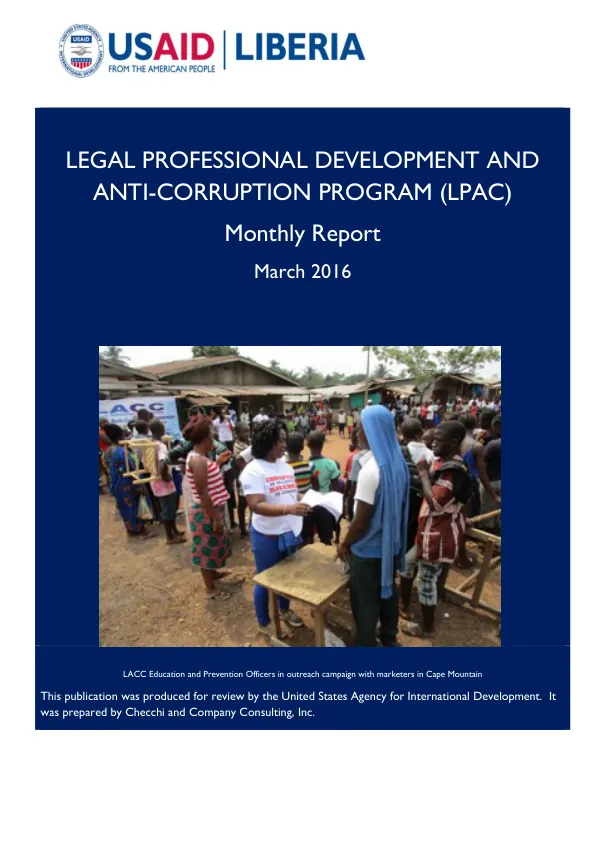
The program aims to increase the capacity of Liberia's legal institutions to produce a high-quality and increased number of judges, magistrates, prosecutors, public defenders, lawyers, and other law-trained actors to maintain an effective legal system, while reducing corruption that undermines that system. LPAC consists of two components structured to address these challenges. The first component comprises capacity building to the four key Liberian justice sector institutions: the Judicial Institute, the Louis Arthur Grimes Law School (Law School), the Liberian Legal Information Institute (LiberLII), and the Liberian National Bar Association (LNBA). These institutions focus on educating, regulating, and informing legal professionals. The second component supports the Liberian Anti-Corruption Commission (LACC) and associated Government of Liberia entities in their efforts to investigate, prosecute, and convict perpetrators of corruption-related crimes, and to educate the public regarding the fight against corruption in Liberia. During the month of March 2016, LPAC achieved several accomplishments. Position vacancies were initiated and/or completed, with the exception of the proposed Fund Raising Coordinator at the Law School. Additional vehicle requirements were also addressed, with USAID approving the transfer of two additional vehicles to LPAC's inventory, although the proposed vehicles have not yet been transferred. Integrated Activity 1, Technology Assessment and Evaluation of Equipment Needs, involved LPAC's ICT Final Assessment Report being forwarded to USAID for review and approval on March 21, 2016. Upon acceptance by USAID, LPAC will share counterpart sections prior to USAID-sponsored MOC technical working group meetings starting later in the month. LPAC has also started work developing ICT equipment and software specifications in anticipation of the USAID approval of the ICT Final Report recommendations. Integrated Activity 2, Review and Agreed on Language of MOCs with USAID, involved USAID returning an approved final draft of the Judicial Institute's (JI) MOC on March 25, 2016, and requesting that LPAC draft similar MOCs for other counterpart agencies based on the approved template. LPAC projects completion of revised counterpart MOCs during the 2nd week of April, 2016, and will then work to schedule USAID-sponsored MOC technical working group meetings starting later in the month. The James A.A. Pierre Judicial Institute (JI) has sustainable capacity to support an accountable judiciary that instills increased trust in Liberia's formal justice system. To achieve sustainability, it will be necessary for the Institute to obtain reliable funding from the Government of Liberia and better manage its scarce resources. LPAC has designated staff for training in administration and financial management, and has begun working with JI to implement work plans and reports for JI's monthly activities, quarterly and annual workshops, and the JI's annual calendar. LPAC has also met with INL, CJPS, and the JI to discuss collaborating on future training programs for Public Defenders and Bailiffs. The meeting addressed plans for the next Public Defender training, including identification of donor partners and logistics and training topics. The Bailiff training was initially proposed by the JI to CJPS, and LPAC was asked to provide advice on gaps in the proposed curriculum and to meet with the JI to discuss the training.