USAID DEC
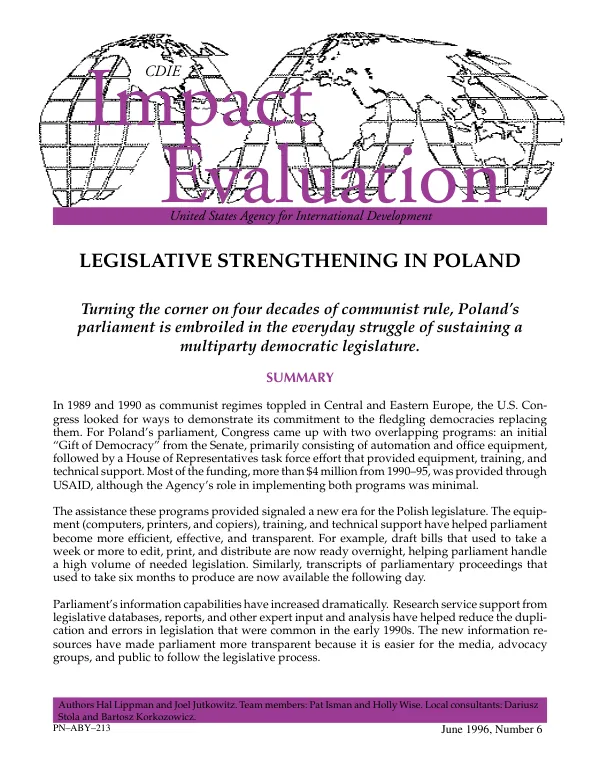
Legislative strengthening in Poland
In 1989, Poland"s parliament was at the center of events that led to Poland"s becoming the first Soviet client state to dissolve its communist-dominated political and economic system.
Lippman, Hal; Jutkowitz, Joel · 1996
Sign in to readA free account is required to download.
Abstract
U.S. support for the parliament has involved two overlapping programs: an initial "Gift of Democracy" from the Senate, primarily consisting of automation and office equipment, and the House of Representatives" Frost Task Force effort involving equipment, training, and technical support. Most of the funding, more than $4 million from 1990-95, was provided through USAID, although the Agency"s role in implementing the programs was minimal. The programs ushered in a new era for the Polish legislature and helped it to become more efficient, effective, and transparent. For example, draft bills that used to take a week or more to edit, print, and distribute are now ready overnight, enabling parliament to handle a high volume of needed legislation. Transcripts of parliamentary proceedings that used to take 6 months to produce are now available the following day. Parliament"s information capabilities have increased dramatically. Research service support from legislative databases, reports, and other expert input and analysis have helped to reduce the duplication and errors in legislation that were common in the early 1990s. The new information resources have made parliament more transparent because it is easier for the media, advocacy groups, and the public to follow the legislative process. All this has helped to make parliament more independent. Its legislative deliberations are more informed and it is now the source of most proposed legislation, although the executive still generates the most significant bills. The assistance had limitations, however. It did not help parliament acquire the capability to adequately review and analyze executive branch budget submissions. In addition, high turnover among legislative staff, who, lacking civil service status, are vulnerable to political pressure, threatens the sustainability of program achievements. Finally, USAID"s minimal involvement meant missed opportunities to link program activities with related USAID lines of effort, such as strengthening democratic local governance and political parties. The assistance successfully met its original objectives -- strengthening parliament"s infrastructure and information capability. However, it did not address other important facets of legislative strengthening, such as constituent relations, links between the legislature and civil society, or public understanding of how a democratic legislature works and what can be expected from it. In sum, the two programs were insufficient as a stand-alone legislative strengthening activity -- a broader mix of support is needed to meet a newly democratic legislature"s diverse needs. Specifically, the study indicates the need to: provide assistance beyond infrastructure and information needs; gain the support of legislative leaders; allocate and distribute assistance fairly; include U.S. and regional training; support development of budget review capability; make staff retention a priority; and ensure broader involvement of the USAID Mission. (Author abstract, modified)
Related documents