USAID DEC
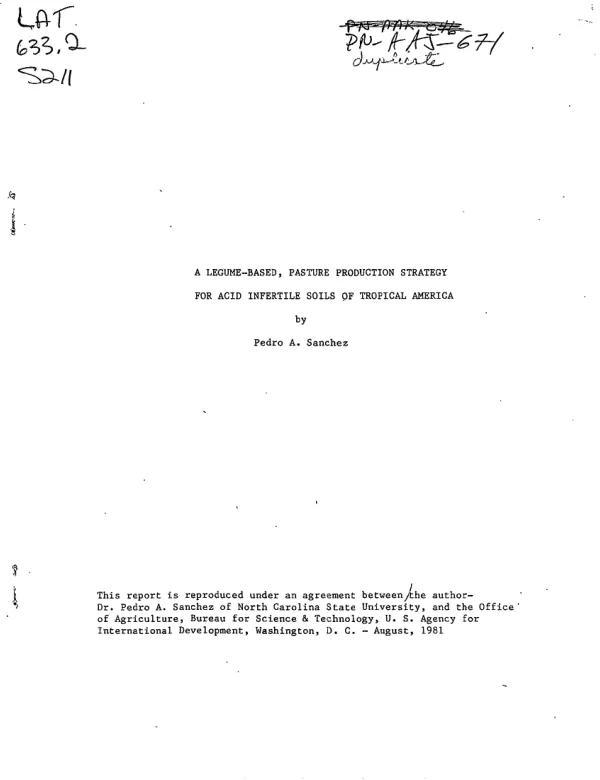
Legume-based, pasture production strategy for acid infertile soils of tropical America
Sign inNORTH CAROLINA STATE UNIVERSITY
Legume-based, pasture production strategy for acid infertile soils of tropical America
Inappropriate land use by farmers, forced by population increases to cultivate lands in acid infertile soil regions, is the cause of widespread erosion in high base status soils in tropical America.
Sanchez, Pedro A. · 1970
Sign in to readA free account is required to download.
Abstract
This paper describes the rationale and outlines the components of a low input soil management strategy designed to replenish these soils into legume-based pastures for beef production by taking advantage of acid soil infertility instead of trying to overcome it with large lime and fertilizer applications. Although not all the strategy"s components are adequately known, the principal components include: (1) use of land resource evaluation studies to select soils suitable for crop-pastures systems, avoiding soils with severe physical constraints; (2) use, in rainforest areas, of appropriate land clearing methods such as slash-and-burn (including its use after mechanized land clearing); (3) selection/breeding of productive, persistent, and compatible pasture grass and legume cultivars tolerant to high levels of aluminum (Al) saturation, low levels of available soil phosphorus (P), major diseases and insects, drought, and burning; (4) supply nitrogen to the system by inoculating legumes with effective, acid-tolerant Rhizobium strains; (5) use low-cost, low-reactivitiy rock phosphates which become readily available when the soil is kept acid and Al-tolerant plants are grown; (6) correct other soil nutrient deficiencies, especially of potassium, sulfur and micronutrients; (7) use low-cost pasture establishment methods such as low-density seedings or interplanting with crops; (8) use low-cost pasture reclamation techniques such as restocking P after burning regrowth; and (9) for extensive cow-calf operations, place l0% of the grazing area in improved pastures. Initial results show that this strategy can provide a continuous protective cover against erosion, promote nutrient recycling, and improve some soil chemical properties. A 47-item bibliography (1965-80) in English, Spanish, and Portuguese is appended.
Related documents
Documents in this collection
 1972
1972USAID DEC
Soil fertility requirements to attain efficient production of food crops on the extensive, deep, well-drained but relatively infertile acid soils of the humid tropics
Open record 1975
1975USAID DEC