USAID DEC
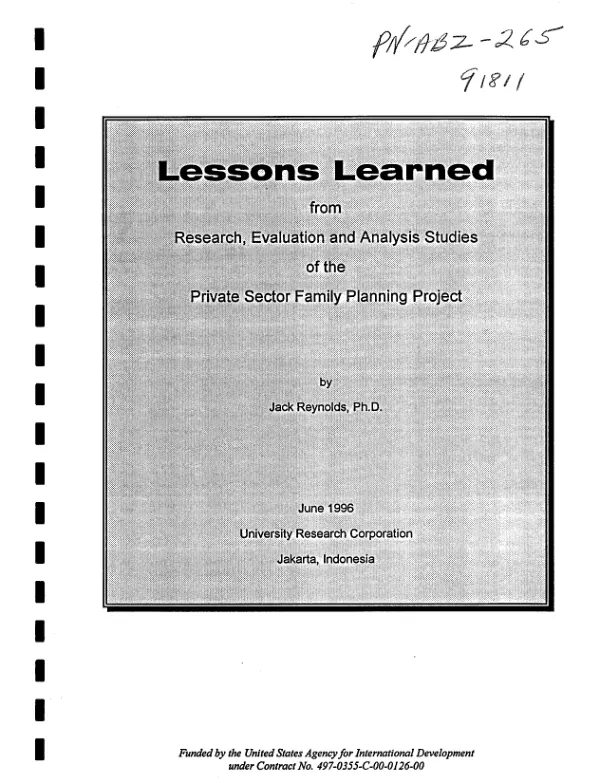
Lessons learned from research, evaluation and analysis studies of the private sector family planning project
Sign inUNIVERSITY RESEARCH CORP. (URC)
Lessons learned from research, evaluation and analysis studies of the private sector family planning project
The purpose of The Private Sector Family Planning project (PSFP), the centerpiece of USAID population assistance in Indonesia between mid-1992 and early 1996, was to increase the use of private sector family planning providers and contraceptives, especially long-term contraceptives (IUDs, implants, and voluntary sterilization).
Reynolds, Jack · 1996
Sign in to readA free account is required to download.
Abstract
While the project was not designed as a research project, a large number of studies were conducted over the project's lifetime, though most of these were for internal purposes and not widely distributed. As the project was ending and it became apparent that its "institutional memory" was at stake, a last minute extension was granted for the abstracting and gleaning of lessons learned from the project's research. This report is in two parts. A first and shorter part presents: (1) general lessons learned, and (2) lessons grouped by project component, namely, social marketing of private sector contraceptives in urban areas, community-based distribution of contraceptive services and products in rural areas, private sector development (especially private midwives, and doctors and pharmacies), and promotion of long-term contraceptive methods. The second and longer part contains 54 study summaries, organized according to the same components. Studies that cover more than one component are grouped under a separate category. An appendix includes a bibliography and an index of key words with pages corresponding to related studies. (Author abstract, modified)
Connected topics