COLUMBIA UNIVERSITY. FACULTY OF MEDICINE. SCHOOL OF PUBLIC HEALTH. CENTER FOR POPULATION AND FAMILY HEALTH
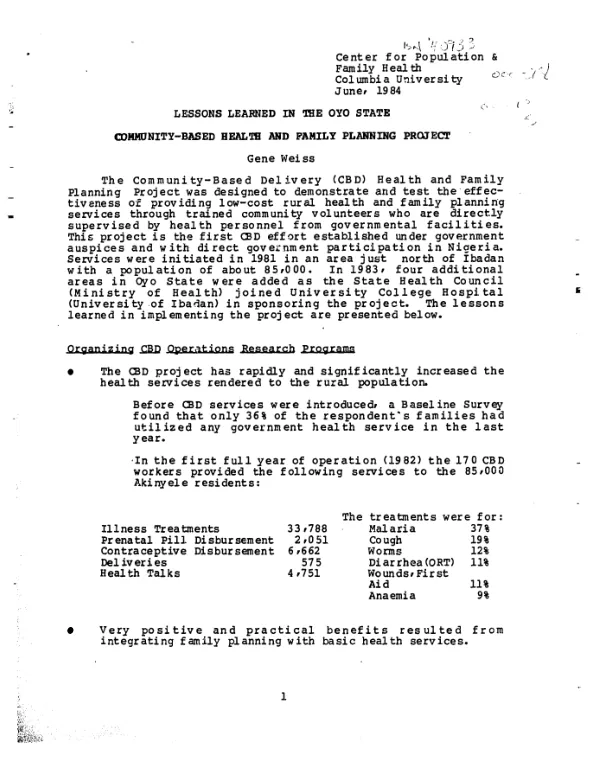
Lessons learned in the Oyo State community-based health and family planning project
Evaluates project to establish and replicate a rural health and family planning (FP) delivery system in Nigeria's Oyo State using trained community volunteers (CV's) supervised by government nurses.
Weiss, Gene · 1984
Sign in to readA free account is required to download.
Abstract
Special evaluation, prepared by Columbia University's Center for Population and Family Health, covers the period 1983-6/84. The project has successfully expanded from the pilot area around Akinyele to four other areas in Oyo and has significantly increased health services rendered to the rural population; nurses and CV's implementing the expanded community-based delivery (CBD) system have been particularly motivated to reach all residents. Project success is due in part to the careful training provided in the pilot area by staff of the original implementor - the University College Hospital (UCH) - for Oyo personnel, who are gradually assuming control of expanded activities. More so than positive political feedback (e.g., resulting from the politically popular use of traditional birth attendants - TBA's - instrumental in increasing FP acceptance) or publicity, word of mouth among health professionals and elites has generated demand for project replication in nearby areas. CV's have effectively provided home health visits and referrals to health centers; wardmaids in particular have assisted nurses well with supervision and FP education. While most CV's are illiterate, 90% have learned to diagnose and treat a few common illnesses; the project has notably developed a pictograph-based sheet for CV recordkeeping. FP is now recognized as an integrated component of basic health services, and while contraception is still not openly discussed (thus the importance of having both male and female CV's), use of modern FP has increased from 2% to about 10% of women of childbearing age and is reducing the practice of postpartum abstinence. The expanded project has proved more replicable and better supported than the pilot as nurses have organized local CBD themselves; the UCH-run pilot, in contrast, has led to poor supervision by government nurse midwives as CV's regard UCH staff as the key supervisors. Although it was found that variables (such as the use of TBA's) among the five areas cannot be controlled for research purposes, conclusions may be drawn from natural variations; use of a microcomputer is expected to increase data collection efficiency.
Related documents
Documents in this collection
![Navrongo community health and family planning project : lessons learned 1994-1998 [-- Ghana]](https://covers.devme.ai/gen/5522.webp)
USAID DEC
Navrongo community health and family planning project : lessons learned 1994-1998 [-- Ghana]
Open record 1999
1999USAID DEC